Monday, October 30, 2006

Infosys plans expansion in Trivandrum

IT services major Infosys, which is on a massive expansion spree, is likely to have its own campus in Thiruvanathapuram in a year or two. N Radhakrishnan Nair, CEO, Technopark campus, who is part of the Kerala delegation at BangaloreIT.in said that the company would have its own campus in the city. “Starting November, Infosys will begin construction of its campus and has taken up 50 acres of land. It plans to have 2.5 million square feet of space that can seat more than 5000 people,” he said.

In the first phase of construction, around 600,000 sq feet of built space will be completed. “The catalyst for the Infosys’ interest in Kerala is the COO Kris Gopalakrishnan who hails from Thiruvananthapuram,” said Nair.

At present, Infosys has more than 500 people working at its facility in Technopark in Thiruvananthapuram. In May this year, senior Infosys executives including Kris Gopalakrishnan met with Kerala CM V S Achuthanandan to discuss their growth plans in Kerala.

The Technopark in Thiruvananthapuram houses 110 companies and 12,500 people. In the next six months, the number of employees is expected to touch 20,000.

Another initiative by the Kerala Government is an integrated township for the IT sector called Technocity. This project would be a private-public partnership involving 500 acres of land very close to the existing Technopark. The land acquisition is expected to happen in the next one year.

Original story

Saturday, October 28, 2006

West Bengal to Provide 100 acres of Land to Infosys

West Bengal, the latest state joining the IT bandwagon, has showcased its strengths and offerings in the knowledge sector at India's premier tech event Bangalore IT.in

The state IT department is processing applications from Infosys and Wipro for allotting about 100 acres and 50 acres respectively on priority. The land clearance for both the IT bellwethers is expected during the current fiscal (2006-07).

Highlighting the state government's initiatives and pro-active policies for the IT sector, West Bengal IT minister Debesh Das said Saturday that world-class infrastructure facilities were being created across the state, especially in Kolkata, for IT and IT-enabled services (ITES).

'We are creating an additional built-up space of about 13 million square feet to generate over 130,000 jobs seats in the next three years in Kolkata. The IT Park being developed by the Delhi-based DLF group will be the largest of its kind in the country,' he told reporters here.

'In addition, a Special Economic Zone (SEZ), spread over 130 acres, has been approved by the central government exclusively for the IT industry, with 30 acres earmarked for the small and medium enterprises (SMEs),' Das said.

Keeping in view the land requirements for future growth, the state IT department plans to acquire about 330 acres near the airport. The West Bengal Electronics Industry Development Corporation (Webel) has already allotted 200 acres at Salt Lake in Kolkata for IT and ITES companies.

'Our government is also setting up a 'knowledge corridor' at Rajarhat in Kolkata for global IT players, including many from Europe and the Silicon Valley. A new town will be built on 8,000 acres with integrated facilities, including schools, hospitals, playgrounds, theatres, shopping complexes and residences,' Das said.

The state IT department is processing applications from Infosys and Wipro for allotting about 100 acres and 50 acres respectively on priority. The land clearance for both the IT bellwethers is expected during the current fiscal (2006-07).

To ensure uniform growth of the IT industry across the state, the West Bengal government is building land banks at Kharagpur, Haldia, Durgapur and Siliguri in the northern region, where the Software Technology Parks of India (STPI) have set up earth stations to provide connectivity on 24x7 basis.

To attract investments in the high-tech areas such as knowledge process outsourcing (KPO), very large system integration (VLSI) design, mobile computing and electronic manufacturing services, an Advanced IT Park and an electronic design automation (EDA) delivery centre will be located near Indian Institute of Technology, Kharagpur, in about 100 acres.

In a bid to minimise the demand-supply gap in human resources, the state government has begun offering incentives and subsidies for setting up IT-centric training institutions.

'With pro-active policies such as flexible labour laws, permission to employ women on 24x7 basis and declaring the IT firms as public utilities, we have created an eco-system to ramp up human resources.

'We propose to include IT in the list of essential services to prevent disruption in their operations due to strike, protests or demonstrations,' Das pointed out.

'With about 45,000 people employed in the IT and ITES space, West Bengal has been growing at about 100 percent annually over the last couple of years. We are aiming to generate around 15 percent of the country's total IT revenue by 2010-11 from the current three-four percent,' he said.

'We are also taking a number of measures to usher in e-governance, by computerising all the 54 departments and connecting them through broadband access to each development block and local body,' Das added.

Original story

WiMAX facility for Infosys Bangalore Employees

SDA-India reports that Aircelhas received requests from IT majors such as Intel, TCS, Infosys and Wipro to provide WiMAX facility to their employees so that they can work out of homes in case of emergencies.

Aircel is a registered member of the WiMAX Forum. Aircel has launched wireless Internet services through WiMAX technology in Bangalore after Chennai. Worldwide interoperability for Microwave Access, popularly known as the WiMAX technology, enables 'last mile' connectivity using Near Line Of Site (NLOS) wireless equipment.

"Initially, Aircel aims to make Bangalore 'wire-free' using WiMAX technology enabling wireless Internet connectivity for SME, enterprise and residential use," said Ram Shinde, senior vice president, Aircel Business Solutions, while announcing the launch.

The release said that Aircel was also identifying and deploying Wi-Fi 'hotspots' throughout the city with indoor and outdoor points backhauled with WiMAX. Internet services at these 'hotspots' would be enabled through pre-paid cards integrated with Payment Gateways for on-line registration and subsequently activated using the 'Authentication, Authorisation and Accounting (AAA) mechanism.

Aircel has enabled the WiMAX based internet connectivity at the Palace Grounds, the venue for the four day Asia's largest IT Event beginning October 28 to enable the exhibitors and business delegates to get a first hand experience of the technology.
The company was also in the process of Wi-MAXing Vidhan Soudha, the state's secretariat that housed the Assembly and the Council, and adjacent buildings belonging to the state government.

The release said with WiMAX, end users could have Internet accessibility based on portable technologies at an affodable price.

WiMAX is unaffected by environmental or climatic disturbances and provided relief to organisations from 'last mile' connectivity concerns both in urban and rural areas with limited network infrastructure. The company also quoted a forecast, which suggested that the WiMAX subscriber base in India was likely to cross 12 million by 2012.

The company had recently launched WiMAX in Chennai with 90 per cent coverage across commercial areas in Chennai and has already enabled wireless connectivity for SME and enterprise clients through WiMAX based on 802.16d standards at a speed range of 2 to 10 Mbps. This would help the end user to stay connected to the Internet and Intranet with high uptime, the company said.

The State Government has invited competitive bids from five entities, including the public sector ITIL, Spanco, Microsense and KBIT to set up a USD 20 million project to unwire Bangalore city covering a serviceable area of more than 500 sq km from January-February next year.

Aircel would team up with either ITI or Microsense depending upon the outcome of the bidding process, the official said.

Original story

Nandan Nilekani is the 'IT person of the year 2006'

Infosys CEO and Managing Director Nandan Manohar Nilekani won the coveted `IT person of the year 2006’ award by Dataquest Magazine. The Dataquest Awards for 2006, which took place in the Capital on Thursday recognized Nilekani’s contribution to the IT industry.

Nilekani, who is deeply involved in pushing the cause of the Indian IT industry is also the co-founder of NASSCOM and the Bangalore chapter of The IndUS Entrepreneurs (TiE). He is also the member of the National Knowledge Commission and part of the National Advisory Group on e-Governance.


The Dataquest IT Lifetime Achievement award was conferred posthumously, to Late Arun Kumar, former Chairman of NASSCOM and former CEO of Flextronics Software Systems.

Prasanto Kumar Roy, President and Chief Editor, CyberMedia Publications said that Kumar played a pivotal role to help open up an avenue of collaboration with the Pakistan IT industry. “He was closely involved in fostering entrepreneurship from TiE, to the band of angels, with strong motivational skills. In 1999, he drove through his software company’s initial public offering (IPO). It was the first successful IPO based on the book-building, price discovery process,” Roy said.

The Pathbreaker of the year 2006 award was conferred to the MCA-21 Project of the Ministry of Company Affairs. Driven by the MCA, this mission project under ht e-Government of India’s National e-Governance plan is a landmark project on a very large scale of information technology in the shortest possible time frame. Y.S. Malik, Joint Secretary MCA, received the award.

Also presented on the occasion were the "Dataquest Top 20" corporate awards. The Best Employer award was conferred to Tata Consultancy Services, Top Growth Company award went to Red Hat India, Innovation award conferred to Microsoft India, Top IT company and Top Software Exporter award given to Tata Consultancy Services, IBM India was adjudged as the Top Server Company, Cisco Systems became the Top Networking Vendor, Top Printing and Imaging vendor award went to HP, NIIT got the Top Training company award, Microsoft India became Top Package Software vendor, Top Distribution award went to Ingram Micro and HCL Infosystem became the Top PC Vendor.

Dataquest Awards are based on the DQ Top20 survey; India's most respected awards of the IT Industry, these awards are given to the leading company in the major IT segments. Dataquest Achievement Awards are a celebration of excellence in IT, the DQ IT person of the Year, The Lifetime Achievement and the Path Breaker awards are an acknowledgement of the exemplary contribution of the evangelists and super- achievers of the Indian IT industry. The DQ Top 20 is the India's most authoritative and respected survey of the IT industry and market, often referred to as the "Bible of the Indian IT industry.

Original story

New generation of leaders ready

We are making sure we have a whole crop of people who can take charge of this company over the next several years. It is reasonable to assume that leadership will be taken by new generation of leaders, says Nandan Manohar Nilekani, CEO and MD, Infosys


Colleagues opine that leadership qualities come naturally to Nilekani. His task at the moment is to tread the fine balance between maintaining Infosys’s values and culture while scaling the company’s business to greater heights.

In an interview with Priya Padmanabhan and Latha Chandradeep of CyberMedia News, the Infosys CEO and MD shared his strategy on how he plans to do this and also capitalize on the dynamic nature of the IT services business landscape.

What are you doing to build leaders for the future?

Leadership development is something we are concerned with. We are obsessed with creating the longevity of the corporation. And about creating a company that goes beyond generations of leaders. When the current set of leaders are no longer there, how do we ensure the longevity of Infosys and continues to thrive, prosper, retain its value and culture, DNA. One of the shortcomings in India is that we don't create multi-generational leaders. So we are trying to do a lot in terms of building, grooming and empowering them and creating career plans for leaders. We are making sure we have a whole crop of people who can take charge of this company over the next several years. It is reasonable to assume that leadership will be taken by new generation of leaders. We have good leaders like Mohandas Pai, Srikanth Batni, Balakrishnan and others. I think we are making sure sustainability is there. That is a very complex exercise.

Does Infosys intend to stick to services alone, or do you plan to expand beyond it?

I think we should not knock what we do. The services business is very strategic, complex, sophisticated and has many business benefits. We are using the knowledge of business, processes, technology, consulting and creating solutions that make global companies more profitable and competitive. I think that's our strength. Our strength is in harnessing people, processes, technology and intellectual capital to create solutions that deliver our customers outcomes for their business. It may be through software, consulting or BPO. Whatever it is, at the end of the day, we look at it from the eye of the customer.

It is a big opportunity. You don't ask Intel why they produce chips. You don't ask Dell why they don't make Operating systems. In every business, every company chooses the playpen in which they wish to operate.

Do you believe the services opportunity is fairly significant and huge for you to continue doing this for the next 10 years?

About 40 per cent of our revenues today comes from services that did not exist five years ago. This is by no means a static organization. Everyday, we are thinking of new services, new offerings, new platforms, new IPs and new forms of operations on optimization. There is a constant churn of offerings.

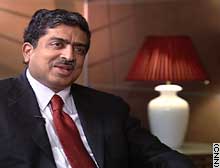
Our point of view is that globally companies are going through a huge challenge. This challenge, in some sense, is similar to what companies Nanadan Nilekani, CEO & MD, Infosys went through a hundred years ago. It is a combination of demographics, emerging economies, globalization, technology, flat world and regulation. There is a fundamental change in the way companies are run today. You can’t run companies the old fashioned way anymore. They have to use technology, process standardization, answer regulators in 50 countries and have to mine data to get profit. We call this whole thing ‘Think flat’. Companies that think flat will look at themselves and think of changes to be made to be effective in a changed world. Infosys itself is an example of a flat company, because we operate in that model. So we are well placed to advise other people on how they can become flat companies. In the next few years, every industry is going to go through this turmoil. There is a role for a trusted partner who can provide advise, guide, provide consulting, technology and IP to help customers make the transition. So there is a huge opportunity.

MNC IT services players are getting into the global delivery model game in a big way. How would you differentiate in this highly competitive arena?

I think global companies are coming here since their customers are telling them to come here. They are demanding this because what we brought to the industry was a disruptive solution. By pioneering and innovating GDM to its current level of sophistication, we brought in a way of service delivery that was faster, better, cheaper and innovative than the legacy way of doing this. In any industry, if there is anything that can give you faster, cheaper and better service, more innovative, it will substitute the old. In that sense, we are setting the agenda globally for how IT services should be delivered. Our customers, employees and investors have understood this. So we think global players who have done things the old way have no choice but to reengineer themselves to look more like us.

We think this is causing enormous disruption and turmoil. They have to figure out how to tackle the backend work, manage internal conflict and pricing tug of war. The model has caused a lot of internal disruption. It is like the innovator's dilemma. They have to untie and reconfigure the entire business model. In the mean time, we are doing what we have been doing better. We are going out into the market and expanding. They have to relearn the business.

Original story

Leading Infosys 2.0

Leadership in transition is a particularly painful time for companies. But not for Infosys and Nandan Manohar Nilekani. This year's Dataquest IT Man Of The Year continues to take Infosys and the Indian outsourcing story to new heights

By Latha Chandradeep and Priya Padmanabhan of COIL

BANGALORE: When we walk in to meet Nandan Nilekani at the Infosys’s corporate headquarters in Electronics City, Bangalore, he is busy munching an apple. He is on a diet, Nilekani tells us between bites, which he follows only when he is in India.

Invariably so, as his overseas visits are packed morning to night with back-to-back meetings, midnight flights and of course, stay in hotel rooms.

Nilekani, the 51-year-old chief executive officer and co-chairman of Infosys, is firmly in place, meeting customers around the world and ensuring that Infosys is delivering on its value proposition, be it in software solutions or consulting services. And now, destiny’s favorite child—Nilekani firmly believes that he was at the right age, at the right time, at the right place with the right people—is on a mission: to make Infosys outlast its founders and become a successful entity run by multi-generational leaders across the world.

Who better than Nilekani to appreciate the value of preparedness? His predecessor N. R. Narayana Murthy, who stepped down as chairman in August, had prepared the entrepreneur-founders in the early nineties to lay the foundation for a scalable Infosys, the benefits of which was reaped only post-2003 when it went past the $1 billion mark and now on track to achieve $3 billion in 2007. Hence, his obsession with creating longevity of the corporation—going beyond generations of leaders—while continuing to thrive, prosper and retain its value and culture, the basic DNA.

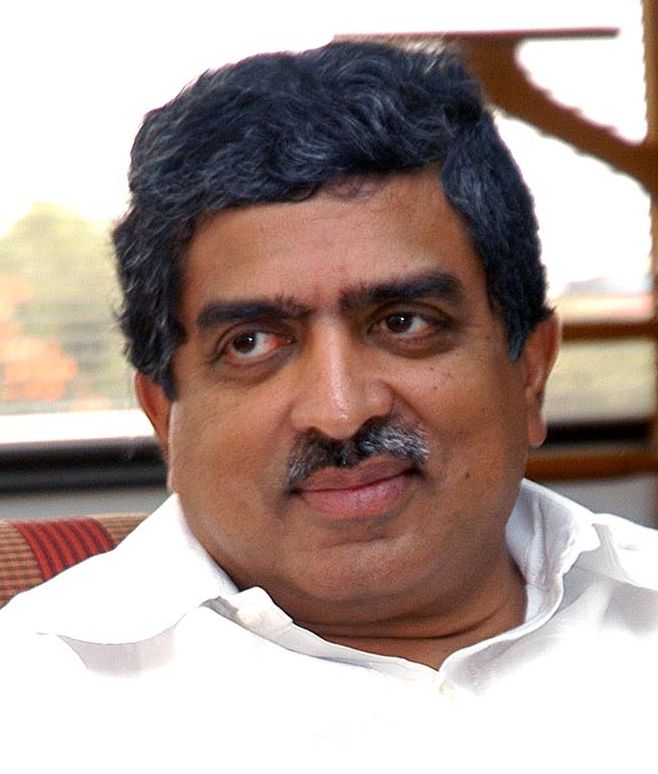
Nanadan Nilekani, CEO & MD, Infosys So far, Infosys strategy has been driven through consensus by a leadership team that has been together for years. Nilekani says: “We have a congruence and commonality of approach. What we have is a collective vision. There may be subtle changes when leaders change. It is not like in western countries where there is a huge change when leaders change. It is more collegial and organic. Core culture and values will be the same. Infosys is really the contribution of many people—not individuals. Sung and unsung people.”

The task, therefore, of creating next gen leaders is easily stated than done. However, Nilekani, naturally inclined to lead and organize, and remain relaxed despite the nature of challenge, sounded clear about one thing: “The children of founders will not work in Infosys. It is a conscious statement. We do not want a company that is inter-generational family set up, but a fully professional one.”

In a way, most of his time today is spent focusing on grooming leaders, empowering them and creating career plans for them. This is similar to changing tires of a car in motion—maintaining the fine and steady balance between achieving rapid growth and scale without compromising on the company’s values, client satisfaction and culture. “The challenge is how to scale up rapidly and also manage execution well so that you don't miss a beat. How do you do things differently from what you have done in the past and achieve your strategic goals of transformation.”

At the very fundamental level, the current leadership team knows it is all about change and managing change. What it has put in place is a three-tiered structured approach to change that lets them do future gazing. Every year, a five-year scenario planning session looks into the basic assumptions (both explicit and implicit) made by the company a few years back to see if they still hold good or is there a need to re-jig to suit a new set of realities.

“Companies run on a set of explicit, tacit assumptions about the market, customers, about the future, world and technology. What happens to them often is that some of those assumptions are changing. There is something happening either in the external environment and internally, where the theory of business is changing,” explains Nilekani.

Once these are set or reset—as the case may be—business units align themselves to the new challenges and business goals. The intermediate three-year strategic planning exercise that follows scenario planning then focuses on translating the strategic stuff into transformation results. It is here, at this point—the nuts and bolts level—that operational excellence is maintained in sync with strategic direction. The delivery of this is ensured through the operational quarterly and annual plan.

This kind of assumption setting has enabled Infosys to quickly capitalize on any opportunity coming its way and hit the ground running at the right time. All of this, in turn, has resulted in 40 per cent of its current revenues coming from services that did not exist five years ago.

Passionate about GDM

One of the country’s most cash-rich companies—close to $1 billion—Infosys’s reluctance to look beyond software services and its Global Delivery Model (GDM) continue to be sore points.

Nilekani refuses to give in and takes the charge head-on, stating, “What we do is very strategic, complex, sophisticated and has many business benefits. We are using knowledge of business, processes, technology, consulting and creating solutions that make global companies more profitable and competitive. Our strength is in harnessing people, processes, technology, intellectual capital to create solutions that deliver our customers outcomes for their business.”

Indeed, by applying the GDM paradigm to consulting—considered to be high-touch business—it has brought about a certain disruption in the business. By reconstituting the services offering in consulting and disaggregating that into high-touch and low-touch, it has been able to deliver services faster, better and cheaper. And, Nilekani believes, anything that is innovative and that which is faster, better and cheaper will substitute the old.

With the confidence of one who knows what it takes, Nilekani adds, “We are setting the agenda globally for how IT services should be delivered. So we think global players who have done things the old way have no choice but to reengineer to look more like us. The model has caused a lot of internal disruption. They (competitors) have to untie and reconfigure the entire biz model. In the mean time, we are doing what we have been doing better.”

The leadership team at Infosys is certainly not getting their knickers in a twist over the entry of global service majors like IBM, HP, Accenture and others and increasing their offshore mix and delivery mechanism. Nilekani reckons that they are rather late to the GDM game and would take a while besides effort and turmoil before they leverage the India advantage.

He likens GDM to the running of a very complex sophisticated global supply chain of information. “It is not something that is easy to replicate. We have created significant barriers of entry around ourselves,” stresses Nilekani.

On leadership and longevity

Unwilling to be put into a specific leadership mould, he states: “There is no cookie-cutter leadership style.” But Nilekani is known for being detached and relaxed amidst crisis, and his ability to get to the heart of the problem while everyone around grapples with it, is a pre-cursor to his style of leadership.

He attributes Infosys’s success to different people who brought different strengths to the table. It has over the years perfected a system (thankfully not made into a fool-proof process yet) where the strengths of people are exploited while a collective safety net deals with the weaknesses of the people.

“One of the unique strengths of Infosys is that the organization is more important than any one individual. Loyalty is to the firm and the vision of the firm and its values and mission. Therefore, we have a simple rule—the interests of the firm override the interests of any individual. That is the final glue.”

It is also a question of the sum being more equal than the parts. Nilekani’s theory of organizational longevity focuses on creating a set of leaders such that “collectively they are capable and individually they are more capable in some of the things.”

Nilekani contends that the attributes of an entrepreneur are great in the beginning but not sufficient to build a large company. “When you have entrepreneurs also playing a leadership role like us, you have to change with the times, otherwise you become obsolete.”

These changes include the conscious steps taken in the early nineties: best practices in budgeting, financial visibility, education and training, and processes besides building world-class campuses. “We built a system for scaling up and made sure the right people occupied the right spots to scale up.”

Nandan Deconstructed

For a person who joined Infosys when he was 25, Nilekani has come a long way both in terms of experience and stature. And it is not just by mere luck alone though that is what Nilekani would ascribe to in his desire to be not seen as larger than life persona.

T.V. Mohandas Pai and Kris Gopalakrishnan, colleagues and close friends, say that he is a natural leader. His penchant for driving strategy and rallying people around comes with an almost effortless ease.

Nilekani sees himself as a “relaxed” kind of person, who is more analytical and cerebral than emotional. “I am relaxed, I don't get flustered too often and I can get detached from any situation. That allows me to step back and look at things in a more dispassionate way.”

Nilekani, the unsophisticated, small-town Dharwad boy rubbing shoulders with the city slickers and well heeled at college, grew up literally and figuratively during his stint at IIT Mumbai. He discovered his organizational skills and his ability to remain detached during crisis, when he organized the annual cultural fest of IIT Mumbai known as Mood Indigo.

Reminiscing on those days he says, “Looking back at my contemporaries in IIT, one thing that stands out is that those who had a well-rounded life have been the most successful. An important lesson is that you need to be multi-dimensional in your interests.”

Nilekani’s interests include reading and music. His musical tastes extend to Simon & Garfunkel, Neil Young, Jethro Tull and Don McLean.

He can hold his own with any great professor or CEO on technology and strategy. Be it holding forth on outsourcing with Thomas L. Friedman or dealing with rookies in the company, Nilekani has the knack to get people on to his side. His innate ability to rally around people and drive strategy was demonstrated early this year at the World Economic Forum at Davos. Nilekani conceptualized and took the lead in pushing the India Everywhere campaign that caught the world’s attention and brought to focus India’s strengths and enormous opportunities.

Kris Gopalakrishnan raves about Nilekani’s ability to bring together diverse sets of people and getting them to work as a team. “He stood out as a leader from day one at Infosys.”

Obviously, there is no escaping comparison between him and Murthy. Mohandas Pai sums up the two: “We have two great leaders in Murthy and Nandan. Their personal styles are very different. Murthy’s style is focused, pushy and aggressive and perseverant, while Nandan is more relaxed and lets you work at your own pace. He pushes you when it comes to need.”

Another aspect of Nilekani’s leadership quality is his knack for connecting dots at various levels and then correlating it to present the big picture along with a strategy to match. Pai relates an incident of how Nilekani’s almost intuitive insights took everyone by surprise when an important customer came visiting.

“We all sat around talking, and within 10 minutes Nandan had analyzed the CEO’s problems and told him what strategy he had to take to run his business. Everybody was astonished because it was a business that we were not in!”

Having achieved so much at the age of 51, Nilekani admits that he has been unusually lucky to achieve so much success. While his personal aspirations are fulfilled, his larger public goal is to contribute in whatever way he can to help India take advantage of this “historical opportunity.”

“India is unusually placed to do well in terms of outsourcing, demographics and the global economy. This is something that comes to a country once in a millennium.”

As for the Dataquest jury, there was no question about the choice for IT Man Of The Year. The panel was unanimous in its recognition of the outstanding work Nilekani has done at Infosys over the past year: “Of the smooth transition at the helm at a time of rapid scaling up and intense competitive pressure; and of the continuing, and considerable contribution to 'brand India' that Infosys, under Nandan's leadership has achieved; and to the Indian technology story on the global platform.”

Amen to that!

Original story

US college grads keen to join Indian firms

Nicole Dun made her way through customs at Bangalore International Airport, then onto a bus bound for Mysore, India, 86 miles away. She was understandably nervous. A freshly minted 22-year-old computer-science graduate of the University of California at Davis, she was leaving the United States for the first time and on her way to her first serious job.

It wasn't at Google, or Cisco, or eBay. Along with about 300 other American college grads over the next year, Dun has signed on as a software engineer with Infosys Technologies, the red-hot Indian engineering firm that plans to add 25,000 employees to its 58,000 over the next year.

She'll train in Mysore for six months before joining Infosys's Fremont, California, office.

Only a few years ago, so-called outsourcers like Infosys were the villains of the high-tech world, accused of farming out work to dirt-cheap programmers in Indian office parks -- and putting Americans out of jobs. Now those same companies are setting up shop in the United States. More striking, there are plenty of young American engineers eager to sign up.

Infosys says more than 1,000 American college students applied for the first 126 spots in its new Global Talent Program. Why? At about $55,000 a year, Infosys's entry-level pay is comparable to that of other engineering employers. But its new hires recognize the benefits of global exposure for their careers.

"The training itself is looked upon highly by other companies," says Brandon Pletcher, a 23-year-old computer-engineering grad from the University of Arizona. "It gives us the edge to do our jobs better."

The new trainees will attend lectures and hone their programming chops, then test those skills in development centers throughout India, working on actual software projects with experienced colleagues.

Dun and Pletcher also emphasize the valuable 'cultural training' they're getting by working with other trainees from India, which is Infosys's intent.

"Creating a multicultural outlook is part of our effort to truly leverage the power of globalization," says Bikramjit Maitra, the company's head of human resources. In the multiculti spirit, it also brought a piece of America to India. "Once we got to campus, there was a bowling alley," says Dun. "I felt like I was home."


Original story

Wednesday, October 25, 2006

Stephen Pratt to Speak in Consulting Summit 2006


Link: http://www.consultingcentral.com/Summit_2006

Stephen Pratt, CEO of Infosys Consuting will be one of the 4 speakers in Consulting Summit 2006 from Kennedy Information.

The sixth annual Consulting Summit is pleased to announce the following conferees:

* Paul A. Laudicina, Chairman, A.T. Kearney
* Chris Meyer, CEO, Monitor Networks
* Stephen Pratt, CEO, Infosys Consulting
* Brad Smith, COO, Kennedy Information

The Summit offers a unique opportunity to network with and learn from other leaders in the consulting profession. The format allows for participation from attendees, and we encourage you to share your thoughts and contribute to the discussion.

Original story

Looking for the World's Best Stocks?

Here are two sobering statistics concerning the state of the U.S. economy:

1. Nine of the 10 largest IPOs of 2006 and 24 of the 25 largest IPOs of 2005 occurred in foreign markets.
2. The economies of Argentina, Belarus, Belize, China, the Czech Republic, India, Indonesia, Ireland, Israel, the Philippines, and Russia are all growing faster than that of the United States.

In other words, not only are we no longer the most dynamic economy in the world, we're not the world's financial capital, either. As Alan Murray wrote recently in The Wall Street Journal, "We are witnessing a crucial moment in history -- the movement of U.S. capital markets abroad."

So why, then, are you investing only in the United States?

All is not lost
Apologies if you're already diversified across some foreign markets. It's true that U.S. investment in foreign securities has been rising rapidly of late. In fact, foreign holdings now account for 17% of all U.S. stock ownership.

But that's still too little. What's holding you back from making foreign securities up to 30% of your portfolio?

I'll take a stab at that one
There are lots of reasons individual investors are concerned about investing in foreign equities. First, accounting rules differ from country to country. Next, there's currency risk and the confusing tax treaties. And then there's government corruption, unstable political climates ... the list goes on.

These risks have probably held you back from stacking up on foreign securities.

But consider: If you're not actively investing in foreign stocks, you're shrugging your shoulders at the incredible growth potential that emerging markets offer. You're also making your portfolio riskier -- because your job, savings, and assets are probably parked right here in the good ol' US of A, meaning you're relying almost entirely on the U.S. economy to help you achieve your financial goals. And while the U.S. economy is strong, significant growth is available elsewhere.

Hot markets, hot returns
Look, the world is changing, and there is no turning back. As retired Infosys Technologies(Nasdaq: INFY) chairman N.R. Narayana Murthy observed in a recent Wall Street Journal editorial, globalization is actually "accelerating."

And know that there are incredible profits to be made from these changes. Just consider the history of Infosys. Mr. Murthy founded the company in 1981 with $250 of seed money. Today, Infosys is worth more than $26 billion. If you're keeping score at home, Infosys has returned 109% annually.

Holy pancakes!

Do those opportunities exist today? Sure. But no one with a conscience can promise 109% annual returns. Of course, that doesn't mean you shouldn't be looking.

Get those global gains
If you're already looking to add international exposure to your portfolio, then you're headed in the right direction. There are many ways to achieve this level of diversification. One way is to invest in American companies that derive significant revenue from foreign countries -- a list that would include Nike(NYSE: NKE), Coca-Cola(NYSE: KO), and Anheuser-Busch(NYSE: BUD).

You could also take a look at a number of low-cost exchange-traded funds. Vanguard Emerging Markets, for example, has returned nearly 18% over the past year and has an expense ratio that dings you just 0.30%. Among its current top holdings are Infosys, Posco(NYSE: PKX), Cemex(NYSE: CX), and China Mobile(NYSE: CHL).

Of course, the downside with funds and conglomerates is that your gains will always be muted. So if you're ready to start searching for promising stocks in international markets, consider joining Motley Fool Senior Analyst Bill Mann and his team at our brand-new Global Gains international investing service.

Never before has The Motley Fool been able to help investors navigate the sometimes muddled waters of foreign markets. Global Gains aims to beat the market with foreign stocks while teaching you how to analyze and invest in other countries. With years of experience living, working, and investing abroad, Bill is more than qualified to help you do just that.

So if you're ready to make your portfolio better diversified and add the potential of great global gains, click here to try our just-launched Global Gains service free for 30 days.

Original story

Joke - Infosys Technologies is Confident about its Aviation Software Prototype

A contract was to be given to Indian vendors like Satyam, Wipro and Infosys to build an aviation software by XYZ aviation company. Now XYZ wishes to test the prototype to evaluate all the vendors. Depending on the prototype evaluation, the final vendor selection will be made.

The XYZ CEO has invited all the vendor CEOs to a party and then take all of them to the personal small plane. He also have done another trick. He called the CEOs individually and told them secretly that the plane is going to use the software for the first time, which is provided by their company. That is Infy's CEO was told that the aviation software installed was build by Infy, Satyam's CEO was told the software was build by Satyam, etc. The plane is going to take every CEO from USA main land to Hawaii, including a tea party in air.

After hearing this, all the CEO's except Infy de-boarded from the plane and provided some excuse for some urgent meetings. They were very sure that the prototype software from their company contains bugs.

The XYZ company's CEO was very impressed on Infy's CEO. He was almost to give the deal to Infy. But just before providing the deal he asked, "Ok you are so confident about your aviation software?".

Infosys CEO then told "Yes. I am so confident the plane will not fly at all, so there is no chance of crash."

Source: Srijeeb @ Orkut