Showing posts with label Tata. Show all posts

Monday, August 13, 2007

Infosys, TCS most reputed corporate houses in India

New Delhi, Aug 13: IT majors Infosys and Tata Consultancy Services (TCS) have emerged as the most reputed corporates in India while Tata Motors, Tata Steel and Hindustan Unilever have tied for the second place, says a corporate reputation index study.

The largest car maker in the country Maruti Udyog has got the third highest number of votes on the index, says the global consultancy firm TNS` latest Corporate Reputation Index.

The research firm said India`s progress is led by IT sector followed by FMCG and Petroleum.

"Corporate reputation is assuming increasing importance in today`s business, economic and social environment. As corporate behaviour is increasingly under scrutiny and corporate valuations go beyond financial performance parameters, it is considered to be a measure of confidence in the organisation and goes much beyond market capitalisation and brand equity," TNS said in a statement.

The corporate reputation index represents stakeholder expectations and experiences with the company and its services, processes, management and systems.

The study reflects views of financial community and senior and middle business managers in the industry. It also includes expectations of opinion leaders which comprise of senior bureaucrats, academicians and media personalities.

A total of 70 leading companies across various sectors were selected for the study conducted in the last quarter of previous fiscal.

While all top five companies figure in lead rankings across all stakeholder groups, the leaders in the respective stakeholder segments include some more corporate houses.

Friday, July 20, 2007

TCS looks better than Infosys on valuation plank

One can build a case for out performance for TCS versus the rest, and not because of what they came out and said yesterday because I didn’t understand where the surprise was from TCS yesterday. The only surprise or the departure between TCS and Infosys was that Infosys gives full year guidance and TCS does not because the Infosys Q1 numbers were not bad at all, they were ahead of street expectations, they have done a reasonable job with their margins as did TCS and they did reasonable job with their topline as well. So if one compared the quarter numbers with TCS and Infosys, I think both came out with reasonable numbers, just that TCS never talks about full year numbers and Infosys came out and said they will revise their guidance downwards.

I don’t think there was any great reason for the market just on the evidence on quarterly numbers to say Infosys is bad and TCS is good. But I think there is a departure now on the valuation plank because if you just look at Infosys is trading at 24times expected even if you assume that they will do Rs 80-81 they are trading at 24 times current years earnings.

TCS assuming that they will do something between Rs 53-54 this year is trading at 21 times and that is 15% valuation gap between TCS and Infosys on similar kind of growth numbers which both are expected to clock.

So if one is comparing the two in difficult environment not knowing what the rupee will do and you still want to be in big IT, you would buy something at 21 times and not 24 times. If one is asking whether TCS has more cushion of comfort built-in, the answer is certainly yes. You can justify it at the end of year if the rupee goes really haywire, can stocks like TCS and Infosys trade at 25 times, it could at the end of the year in which case you can build a Rs 1,350 kind of scenario for TCS which is Rs 200 upside from current levels but Infosys is already there at 24 times and so even if it gets to 25, it doesn’t give you too much bank for the buck.

So relatively speaking between the two you could argue for TCS more than Infosys.

Saturday, October 21, 2006

Tata-Corus deal, sign of confident India Inc: CII

The Confederation of Indian Industry has said the Tata Steel-Corus deal is a sign of a confident India Inc and reflects the consolidation of the Indian industry in the global economy.

CII President R Seshasayee said the deal is a sign of India Inc being recognized as a very significant global economic player. The "internationalization" of the Indian corporate sector has reached a new high with this landmark deal, he said.

Sunil Kant Munjal, past president, CII, said the deal signified -- Indian companies, especially larger corporates, are pursuing global aspirations, groups like Tatas are showing leadership in many fields and the Indian steel industry seems to have come of age, having been at the beginning of consolidation last year.

"This is a precursor of what we can expect over three to four years, he said.

Rajive Kaul, past president, CII and chairman, CII International Council, said the deal was reflective of the consolidation of the Indian industry in the global economy.

CII chief mentor Tarun Das said this is the first scaling up of an Indian company to global scales. The deal "is a result of a dialogue between Tata Steel and Corus, the whole strategy is a reflection of the Tata philosophy of working with partners, with values and ethics. It is a different role model of acquisition and it is unique."

Echoing the sentiments, DS Brar, Chairman, CII Indian MNCs Council, said, "There is tremendous growth potential for Indian MNCs. Change in domestic environment has encouraged and propelled Indian companies to go global."

He said the Indian corporate sector had witnessed active overseas investment in diverse sectors since 2005-06, with top 10 overseas investments totaling $4556 million. It is in keeping with this trend, said Brar, that CII and Infosys have launched the plan to create 100 Indian MNCs. The initiative will provide an "ecosystem" for entrepreneurs and Indian companies to accelerate growth as successful next generation billion dollar MNCs.

The CII-Infosys initiative will include sharing of practical experiences of successful Indian MNCs mentoring, introducing global best practices, involve knowledge partners and nurture aspiring MNCs.

CII and Infosys have received an overwhelming response to the programme and companies like ICICI Bank have shown interest in partnering with them.

There are 37 companies in India with a turnover of over $1 billion. The programme aims to explore the potential of leveraging their experience. The successful companies will help mentor the aspiring 100 Indian MNCs.

Original story

Wednesday, October 04, 2006

Joke - Elephant and Infosys, Wipro & TCS Folks

Another email forward.

One day, three consultants, one from Wipro, one from Infosys and one from TCS, went together for a walk. They were old buddies from b-school, and they were joining together to remember the tough old days they went as students together.

For no apparent reasons, they went into this zoo an passed an elephant.Having worked in the same field and from the same school, of course there is a little bit of peer competition going on between themselves, so when he saw this elephant, an idea clicked the Infosys guy, he said to the others ' Why don't we prove who are the best among ourselves?'. The other two, of course, agreed.

Then the Infoscion said 'Let's make a test. Whoever can make this elephant to laugh, he works for the best firm'.

After they all agreed, they started. Being a pure logical strategist, the Infoscion tried to make the elephant laugh by telling jokes. Of course it stayed still... As a more practical consultant, the Wipro guy tried to make funny gestures... and the elephant still stayed still.... Now, comes the TCS guy.. Being the practical guy he was always told to be, he whispered something to the elephant, and it laughed at him while pointing its fingers to him...

The other two were astonished. How come this TCS guy be able to beat them? So the Wipro guy said 'OK, let's make another test. Let's make this elephant cry !!'. So there they went again, practicing the same method as before. The Infosys guy told sad sad stories, the Wipro guy made sad gestures, and they fail again......

Then, the TCS guy whispered something again to the elephant's ear and it just cried, weeping.....and patting the TCS guy's shoulder.
This cannot be, thought the other two. So the Infoscion said 'OK, you've won twice. If you can win this test, we will bow to you. Let's make this elephant run'.

He went and bark to the elephant orders to run. Of course, it stayed still .... The Wipro guy pushes the elephant and stab it with stake to make it run, it stayed still. So...our TCS guy come to it and whispered something again to it's ear and the elephant run and run as fast as it could, as if it was scared to death.

The other two surrendered. They say 'OK, you're the best pal. You work for a very good firm, tell us your secret'.

'Well' said the TCS guy, 'the first time I made it laugh, I said I work for TCS'.

' When I made it cry as if it were very sad and patted me, I told the elephant how much I get paid'.

' And when I made it run scared to death, I said to it, Why don't you join TCS?'

Saturday, September 23, 2006

TCS Overtakes Infosys in Market Capitalisation

Tata Consultancy Services Limited (TCS) has replaced Infosys Technologies as the country's biggest IT firm and second biggest private sector company in terms of the market capitalisation.

TCS, the country's largest software exporter, achieved a market cap of Rs 1.02 lakh crore, surpassing Rs 1.01 lakh crore of its closest rival in the IT space Infosys.

TCS has also replaced Infosys as the country's fourth most valued publicly listed corporate entity after ONGC, Reliance Industries and NTPC. Wipro retained its position as the third largest IT firm with a market cap of Rs 74.5 lakh crore at the end of today's trading session.

Original story

Monday, September 18, 2006

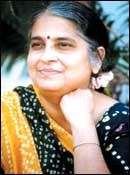
Remembering JRD Tata and Jamsetji Tata - Sudha Murthy

- An article by Sudha Murthy

Sudha Murty was livid when a job advertisement posted by a Tata company at the institution where she was completing her post graduation stated that 'lady candidates need not apply'. She dashed off a postcard to JRD, protesting against the discrimination. It was the beginning of an association that would change her life in more ways than one

There are two photographs that hang on my office wall. Every day when I enter my office I look at them before starting my day. They are pictures of two old people. One is of a gentleman in a blue suit and other is a black-and-white image of a man with dreamy eyes and a white beard.

People have asked me if the people in the photographs are related to me. Some have even asked me, "Is this black-and-white photo that of a Sufi saint or a religious guru?" I smile and reply "No, nor are they related to me. These people made an impact on my life. I am grateful to them." "Who are they?" "The man in the blue suit is Bharat Ratna JRD Tata and the black-and-white photo is of Jamsetji Tata." "But why do you have them in your office?" "You can call it gratitude."

Then, invariably, I have to tell the person the following story.

It was a long time ago. I was young and bright, bold and idealistic. I was in the final year of my master's course in computer science at the Indian Institute of Science [IISc] in Bangalore, then known as the Tata Institute. Life was full of fun and joy. I did not know what helplessness or injustice meant.

It was probably the April of 1974. Bangalore was getting warm and red gulmohars were blooming at the IISc campus. I was the only girl in my postgraduate department and was staying at the ladies' hostel. Other girls were pursuing research in different departments of science. I was looking forward to going abroad to complete a doctorate in computer science. I had been offered scholarships from universities in the US. I had not thought of taking up a job in India.

One day, while on the way to my hostel from our lecture-hall complex, I saw an advertisement on the notice board. It was a standard job-requirement notice from the famous automobile company Telco [now Tata Motors]. It stated that the company required young, bright engineers, hardworking and with an excellent academic background, etc.

At the bottom was a small line: "Lady candidates need not apply." I read it and was very upset. For the first time in my life I was up against gender discrimination.

Though I was not keen on taking up the job, I saw it as a challenge. I had done extremely well in academics, better than most of my male peers. Little did I know then that in real life academic excellence is not enough to be successful.

After reading the notice I went fuming to my room. I decided to inform the topmost person in Telco's management about the injustice the company was perpetrating. I got a postcard and started to write, but there was a problem: I did not know who headed Telco. I thought it must be one of the Tatas. I knew JRD Tata was the head of the Tata Group; I had seen his pictures in newspapers (actually, Sumant Moolgaokar was the company's chairman then).

I took the card, addressed it to JRD and started writing. To this day I remember clearly what I wrote. "The great Tatas have always been pioneers. They are the people who started the basic infrastructure industries in India, such as iron and steel, chemicals, textiles and locomotives. They have cared for higher education in India since 1900 and they were responsible for the establishment of the Indian Institute of Science. Fortunately, I study there. But I am surprised how a company such as Telco is discriminating on the basis of gender."

I posted the letter and forgot about it. Less than 10 days later, I received a telegram stating that I had to appear for an interview at Telco's Pune facility at the company's expense. I was taken aback by the telegram. My hostel mates told me I should use the opportunity to go to Pune free of cost and buy them the famous Pune saris for cheap! I collected Rs 30 each from everyone who wanted a sari. When I look back, I feel like laughing at the reasons for my going, but back then they seemed good enough to make the trip.

It was my first visit to Pune and I immediately fell in love with the city. To this day it remains dear to me. I feel as much at home in Pune as I do in Hubli, my hometown. The place changed my life in so many ways.

As directed, I went to Telco's Pimpri office for the interview. There were six people on the panel and I realised then that this was serious business. "This is the girl who wrote to JRD," I heard somebody whisper as soon as I entered the room. By then I knew for sure that I would not get the job. That realisation abolished all fear from my mind, so I was rather cool while the interview was being conducted.

Even before the interview started, I reckoned the panel was biased, so I told them, rather impolitely, "I hope this is only a technical interview." They were taken aback by my rudeness, and even today I am ashamed about my attitude.

The panel asked me technical questions and I answered all of them. Then an elderly gentleman with an affectionate voice told me, "Do you know why we said lady candidates need not apply? The reason is that we have never employed any ladies on the shop floor. This is not a co-ed college; this is a factory. When it comes to academics, you are a first ranker throughout. We appreciate that, but people like you should work in research laboratories."

I was a young girl from small-town Hubli. My world had been a limited place. I did not know the ways of large corporate houses and their difficulties, so I answered, "But you must start somewhere, otherwise no woman will ever be able to work in your factories."

Finally, after a long interview, I was told I had been successful. So this was what the future had in store for me. Never had I thought I would take up a job in Pune. I met a shy young man from Karnataka there, we became good friends and we got married.

It was only after joining Telco that I realised who JRD was: the uncrowned king of Indian industry. Now I was scared, but I did not get to meet him till I was transferred to Bombay. One day I had to show some reports to Mr Moolgaokar, our chairman, who we all knew as SM. I was in his office on the first floor of Bombay House [the Tata headquarters] when, suddenly, JRD walked in. That was the first time I saw 'appro JRD'. Appro means 'our' in Gujarati. That was the affectionate term by which people at Bombay House called him.

I was feeling very nervous, remembering my postcard episode. SM introduced me nicely, "Jeh (that's what his close associates called him), this young woman is an engineer and that too a postgraduate. She is the first woman to work on the Telco shop floor." JRD looked at me. I was praying he would not ask me any questions about my interview (or the postcard that preceded it). Thankfully, he didn't. Instead, he remarked. "It is nice that girls are getting into engineering in our country. By the way, what is your name?" "When I joined Telco I was Sudha Kulkarni, Sir," I replied. "Now I am Sudha Murty." He smiled that kindly smile and started a discussion with SM. As for me, I almost ran out of the room.

After that I used to see JRD on and off. He was the Tata Group chairman and I was merely an engineer. There was nothing that we had in common. I was in awe of him.

One day I was waiting for Murthy, my husband, to pick me up after office hours. To my surprise I saw JRD standing next to me. I did not know how to react. Yet again I started worrying about that postcard. Looking back, I realise JRD had forgotten about it. It must have been a small incident for him, but not so for me.

"Young lady, why are you here?" he asked. "Office time is over." I said, "Sir, I'm waiting for my husband to come and pick me up." JRD said, "It is getting dark and there's no one in the corridor. I'll wait with you till your husband comes." I was quite used to waiting for Murthy, but having JRD waiting alongside made me extremely uncomfortable.

I was nervous. Out of the corner of my eye I looked at him. He wore a simple white pant and shirt. He was old, yet his face was glowing. There wasn't any air of superiority about him. I was thinking, "Look at this person. He is a chairman, a well-respected man in our country and he is waiting for the sake of an ordinary employee."

Then I saw Murthy and I rushed out. JRD called and said, "Young lady, tell your husband never to make his wife wait again."

In 1982 I had to resign from my job at Telco. I was reluctant to go, but I really did not have a choice. I was coming down the steps of Bombay House after wrapping up my final settlement when I saw JRD coming up. He was absorbed in thought. I wanted to say goodbye to him, so I stopped. He saw me and paused.

Gently, he said, "So what are you doing, Mrs Kulkarni? (That was the way he always addressed me.) "Sir, I am leaving Telco." "Where are you going?" he asked. "Pune, sir. My husband is starting a company called Infosys and I'm shifting to Pune." "Oh! And what you will do when you are successful?" "Sir, I don't know whether we will be successful." "Never start with diffidence," he advised me. "Always start with confidence. When you are successful you must give back to society. Society gives us so much; we must reciprocate. I wish you all the best."

Then JRD continued walking up the stairs. I stood there for what seemed like a millennium. That was the last time I saw him alive.

Many years later I met Ratan Tata in the same Bombay House office, occupying the chair JRD once did. I told him of my many sweet memories of working with Telco. Later, he wrote to me, "It was nice hearing about Jeh from you. The sad part is that he's not alive to see you today."

I consider JRD a great man because, despite being an extremely busy person, he valued one postcard written by a young girl seeking justice. He must have received thousands of letters every day. He could have thrown mine away, but he didn't do that. He respected the intentions of that unknown girl, who had neither influence nor money, and gave her an opportunity in his company. He did not merely give her a job; he changed her life and mindset forever.

Close to 50 per cent of the students in today's engineering colleges are girls. And there are women on the shop floor in many industry segments. I see these changes and I think of JRD. If at all time stops and asks me what I want from life, I would say I wish JRD were alive today to see how the company we started has grown. He would have enjoyed it wholeheartedly.

My love and respect for the House of Tata remains undiminished by the passage of time. I always looked up to JRD. I saw him as a role model for his simplicity, his generosity, his kindness and the care he took of his employees. Those blue eyes always reminded me of the sky; they had the same vastness and munificence.

* Sudha Murty is the chairperson of the Infosys Foundation. She is involved in a number of social development initiatives and is also a widely published writer.

Full story

JRD Tata's Words Inspired me in Philanthropy: Sudha Murthy

Did anybody know that there was a strong Tata connection to Infosys? Meet Ms Sudha Murthy, the better half of the Infosys chairman, NR Narayana Murthy. On a down-the-memory-lane visit here after 25 years, Ms Murthy, who is now heading the Infosys Foundation, said it was a chance association with the house of Tatas when after topping the graduating class in computer science from the Indian Institute of Science, Bangalore, she came across a job advertisement in February 1974, which said Telco (Tata Engineering and Locomotive Company) wanted bright young graduates.

However, much to her disappointment, she found in the footnote it was written "female candidates need not apply." Her ego deeply hurt, she shot off a 'postcard' to JRD Tata asking him how a leading and progressive house like the Tatas, "which always thought ahead of time, could put such a restriction." "After posting it I forgot about it," she said. A pleasant surprise awaited her. A telegram soon arrived asking her to appear for an interview "with a promise of reimbursement of first class fare both ways," she said.

Selected as a GT (graduate trainee) and as the first lady technical officer at Telco, she was first posted to Pune and was later shifted to Telco Jamshedpur "for a short stint." She was thereafter shifted to Bombay House, She had later learnt that JRD had himself intervened in the matter following her letter and had instructed the board that "if she was found up to the mark in her subjects, she should be taken." She recalls how after having put in her papers in February 1982, after having served Telco for eight years, she wanted to meet JRD to convey her gratitude.

"It was again a chance meeting as I was going downstairs and he was climbing upstairs in Bombay House," she told reporters here Monday. "I told him I was leaving the job. He said "you fought so much for the job and nowyou are quitting it?" I told him that my husband wanted to start the Infosys Adventure. And then JRD turned almost a soothsayer to say, "If you make lots of money you must give it back to society as you have received so much love from it." "That was the last time I saw him," the lady, clad in simple clothes, said regretfully.

This was to be the source of the inspiration for Infosys Foundation which she today manages to run in Karnataka, Andhra Pradesh, Tamil Nadu and Orissa "with only six hands." So strong has been the influence of the Tatas that when asked by her colleagues as to what she wanted on her retirement, she could only say: "A black & white portrait of Jamshetji Nusserwanji Tata and another of JRD Tata in his famous blue suit."

"At Infosys, we have the two biggest and the most expensive boardrooms (of a total of 17) where world leaders like Tony Blair, etc, are felicitated, named after these two great personalities," she says proudly. The Infosys Foundation focuses on two basic things: education and health. "We provide infrastructure to the states for building government hospitals," she says. Asked, how was it helping the poor, given the poor state of affairs at government hospitals, Ms Murthy says: "The poor have no other place to go other than to a government hospital."

The foundation, among other things, also donates books to libraries of schools for the less privileged. "The creation of wealth by legal and ethical means is one part," she maintains. "The distribution of wealth is the other part. The Infosys Foundation focuses on the poorest of the poor." Recipient of several international and national awards for outstanding philanthropic work, the chairperson of Infosys Foundation feels that Indian corporates should "do much more for the society," particularly in health and education. Anybody in her place would be having a I high-flying lifestyle.

Full story