Showing posts with label Narayana Murthy. Show all posts

Friday, September 07, 2007

Got a question for Narayana Murthy?

/photo.cms?msid=2340909
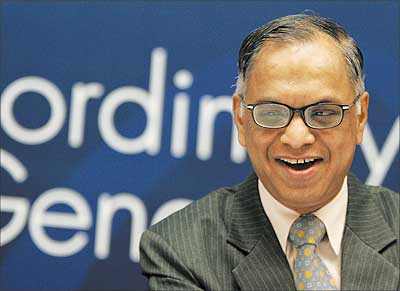
Chief Mentor of Infosys and IT icon N R Narayana Murthy will be the Guest Editor at Economictimes.com on Monday, September 10.

Apart from handpicking articles for display, he will be available on chat between 1815 hrs IST (1245 hrs GMT) and 1945 hrs IST (1415 hrs GMT) that day to interact live and exclusively with our readers. Be sure to log on and chat one on one with Mr Murthy.

If for some reason, however, you are unable to chat with him, but would still like to pose a question, send it in here .

It could be a personal career question, a general question or perhaps something you always wanted to know about Narayana Murthy but didn't know who to ask. Mr Murthy will answer selected questions and we will feature them on Economictimes.com.

Thursday, August 16, 2007

The 8 visions that changed the face of India - Narayana Murthy

/photo.cms?msid=2268442

India completes her 60th year as a free nation on August 15, 2007. According to the Hindu tradition, completion of 60 years is a landmark event in the life of any person and celebrates the wisdom, maturity, accomplishment and the readiness to enter vanaprasta asrama (a phase of life marked by renunciation of worldly responsibilities, and detachment from power, desire, and wealth). However, 60 years is a short span in the life of a nation, and barely marks the first baby steps of a toddler. Hence, any assessment of India has to be generous and optimistic.

We have made decent progress in several areas during the last 60 years. We have produced world-class scientists, engineers, journalists, soldiers, bureaucrats, politicians and doctors. We have built complex bridges and dams. We have sent satellites and rockets into space. We have increased the number of doctors ten-fold. We have increased life expectancy from 32 years to 65 years. We have built about 20 lakh km of new roads; we have multiplied our steel production by over 50 times and cement production by almost 20 times. We have increased our exports from a few million dollars at the time of Independence to more than $125 billion now.

There is an equally convincing set of data to show that we have a long way to go in certain other areas. A whopping 350 million are illiterate; 260 million people are still below the poverty line; 150 million people lack access to drinking water; 750 million people lack decent sanitation and 50 per cent of the children are below acceptable nutrition levels. And basic medicines are unavailable in 75 per cent villages.

Be that as it may, today, I want to focus on a few major achievements that have transformed the lives of our people in a way we never imagined would happen:

Green revolution
Perhaps, no other Indian initiative has enhanced the national confidence as the Green Revolution initiated by Dr Swaminathan. This revolution, which started in 1965, not only transformed India into a food-surplus economy from a food-deficit economy, but also triggered the expansion of the rural, non-farm economy. The lives of at least 400 to 500 million Indians have been uplifted due to this initiative. From being a perennial importer of grains, India became a net exporter of food grains ten years ago.

White revolution
Coming from a generation which experienced an acute shortage of milk, it is unimaginable that, today, we have become the largest producer of milk in the world. The credit goes to the extraordinary vision of Dr Varghese Kurien, continued ably by Amrita Patel. In a nation where children are malnourished, such abundance of milk has offered us the opportunity to fight malnutrition.

Economic reforms of 1991
The economic reforms of 1991 - initiated by the late Narasimha Rao, Dr Manmohan Singh, Shri P Chidambaram and Dr Montek Singh Ahluwalia - opened up the minds of Indian corporate leaders to the power of global markets, helped them accept competition at home and abroad, and raised the confidence of consumers. Our hard currency reserves have gone up from a mere US$ 1.5 billion in 1991 to over US$ 220 billion today. The reforms encouraged entrepreneurship, and gave confidence to businessmen and entrepreneurs to dream big, create jobs, enhance exports, acquire companies abroad and follow the finest principles of corporate governance.

Independent media and brave journalists
The success of a democracy depends upon certain important values of governance - fairness, transparency and accountability. The freeing of media, particularly the television medium, has laid the foundation for improving these values in our governments. The courage, enthusiasm and the zeal to seek truth of scores of idealistic journalists and editors like N Ram, Arun Shourie, Shekhar Gupta, Sucheta Dalal, Barkha Dutt and Rajdeep Sardesai, just to mention a few from the English press and TV, are what make us feel confident that the future of this country is safe.

Telecom revolution
No other technology has brought India, the urban and the rural, together as the 500-line EPABX designed and implemented by the Centre for Development of Telematics (CDOT) under the leadership of Sam Pitroda. This programme brought fresh confidence to the people as they could reach out, in a jiffy, to their loved ones, the officials, and the doctors, just to name a few. People no more feel that they live in isolation.

Space Technology
Prof Yash Pal's Satellite Instructional Television Experiment (SITE) blossomed into a full-scale television facility connecting millions of villages of India. The television medium has made our political masters realise that their actions and inactions will be seen and judged by every citizen - from the forgotten villages of Assam to the activist villages of Kerala. This technology has given voice to the opinions of a billion people - the rich and the poor, the educated and the uneducated, and the powerful and the disfranchised.

Atomic Energy
Dr Bhabha conceptualized the Indian nuclear program and initiated nuclear science research in India. His program has made possible successful utilization of nuclear energy in defence, power generation, medicine and allied areas. Our peaceful use of nuclear energy has raised India's prestige as a mature and responsible player in this field.

Software revolution
N Vittal's Software Technology Program, along with economic reforms of 1991, laid the foundation for this industry's spectacular progress. India's IT exports grew from a mere $150 million in 1991-92 to $31.4 billion in 2006-07, and is projected to reach $60 Billion by 2010.

The Information Technology (IT) industry is unique due to several reasons. It focused on exports; benchmarked with the best global companies; followed the finest principles of corporate governance; created the largest number of jobs in the organized sector; and demonstrated that Indians too could succeed in the most competitive global markets.

Conclusion
What do these eight programmes have in common? They were all led by visionaries. These visionaries accepted global benchmarks and settled for nothing less despite tremendous odds. In each of these initiatives the national government was a genuine catalyst supported by some extraordinary politicians and bureaucrats. These examples clearly show how the people and the government can work together to achieve what is thought impossible.

What do I expect from the India of 2067? I want an India where every child will have access to decent education, healthcare, nutrition and shelter. I want an India where every child belonging to every race, religion and caste is confident that there is a bright future for him/her if he/she is honest and hardworking. I want an India which receives respect from every global forum because we Indians will be peace-loving; we will be gracious hosts; we will be fair; we will be pluralistic and respect every faith; we will be trustworthy and our aspirations and accomplishments will be high.


(The author is Chairman of the Board, Infosys Technologies Limited.)

Original Story

Madhavan gears up to quiz Narayana Murthy

Mumbai, Aug 16 (IANS) Tamil superstar R. Madhavan has been on cloud nine ever since Infosys chief mentor N.R. Narayana Murthy expressed a desire to be interviewed by him. The much anticipated interaction will happen in Singapore on Aug 17.

This is how it happened: Murthy was asked to speak at the Singapore Expo on business relations between India and Southeast Asia and he made a counter suggestion - why do a monologue, why not an interface?

"I'd rather be interviewed by Mr. Madhavan?" Murthy suggested to the Expo authorities.

Madhavan, a big fan of Murthy, is walking on air.

"I've that e-mail which I'll keep till the end of time. I've always been a big fan of Mr. Narayana Murthy. He's certainly one of my idols. I still remember his interview with Bill Gates where he had said, 'The real power of money is the power to give it away'. I'll never forget that line," said Madhavan.

The actor is hoping his interface with Murthy will have its lively and informative moments.

"I don't want it to be cut and dried. The very fact that he asked for me puts a big responsibility on my shoulder. And I intend to take that responsibility very seriously."

Madhavan has just returned from Singapore from the premiere of his latest Tamil film "Aarya".

"But I don't mind going back so quickly. My wife Sarita is coming with me. She says she wouldn't miss this historic moment in my life for anything in the world."

Original Story

Wednesday, August 15, 2007

HC quashes case against Infosys Chief Narayana Murthy

The Karnataka High Court has quashed the case pertaining to 'dishonouring National Anthem' against Infosys Chief mentor Narayanamurthy.

Justice K Bhakthavatsala, allowing a petition by Mr Narayanamurthy, seeking quashing of the proceedings initiated against him by the Second Additional Chief Metropolitan Court, Bangalore, taking cognisance of a complaint filed by Kannda Rakshana Vakilara Vedike, quashed the case.

The Judge said he (Mr Narayana murthy) had not committed any violation of the Act and playing of instrumental version of the National Anthem was not offensive.

Earlier, the complainant alleged that the petitioner Naraynamurthy had committed a crime under Section 3 of the Prevention of Insult to National Honour Act.

The complainant alleged that Mr Narayanamurthy had prevented singing of the National Anthem and merely allowed the Anthem to be played on instruments during former President A P J Kalam's visit to Infosys Mysore campus on April 8.

In his petition, Mr Narayanamurthy contended that the magistrate had no jurisdiction in taking cognisance and issuing a summons.

Original Story

Saturday, August 11, 2007

Murthy on Globalisation and Global Managers

MADURAI: The success of developing countries in the globalised world would depend on how fast new ideas were developed and implemented to gain competitive advantage, Infosys chief mentor N R Narayanamoorthy said on Friday.

In a globalised world, every nation had something to contribute to improve the standard of living of people throughout the world, he said in his 3rd Founders Day Memorial lecture at the Thiagaraja School of Management here tonight.

He said globalisation had given an opportunity to the developing nations to take share of limelight. Besides, they accounted for more than half of the world's GDP. Indian companies and

Indian operations of companies like Intel, Cisco and Texas Instruments were able to patent 1,000 applications in a single year in 2004, and China was able to produce ipods that was a big hit in the USA, he said.

But the globalisation had also led to intense competition as innovation could come from anywhere in the world -- both developed and the developing -- and lifestyles of the people also underwent transformation due to globlalisation.

With improved employability and enhanced per capita income, the consumber base also had shifted to the developing economies like India. There was no need to think of just the 'rich' customers of the developed economies.

Referring to the attributes of the global manager, he said the person should be able to get the best out of people working under him. Apart from building strong value system, he must be open to new ideas, people, cultre and paradiggm. He should believe in hierarchy of ideas rather than that of men and women.

He should also be generous and share the credit for his achievements with everyone of his team.

Original Story

Wednesday, August 01, 2007

Hearing on Narayana Murthy’s petition adjourned

The Karnataka High on Monday adjourned further hearing on a criminal petition by Infosys Chief Mentor N.R. Narayana Murthy seeking quashing of proceedings initiated against him in a lower court.

In his petition, Mr. Murthy said a Bangalore court had issued summons to him following a private complaint by the Kannada Rakshana Vakeelara Vedike.

The vedike had filed a private complaint before the Second Additional City Metropolitan Magistrate (ACMM) against Mr. Murthy for his alleged remarks on singing of the National Anthem. Mr. Murthy had moved the High Court for quashing the May 26, 2007 order passed by the ACMM in issuing process (summons) to him. The vedike claimed that Mr. Murthy had made insulting remarks about the anthem during a media interaction on April 8 after the then President A.P.J. Abdul Kalam visited the corporate education centre of Infosys at Mysore. Senior advocate K.K. Venugopal, appearing for Mr. Murthy, said the complaint was misconceived and that the ACMM could not have taken cognisance of it. He said though the remark was allegedly made in Mysore, a Bangalore court had taken cognisance of it, asking him to be present on June 21.

He informed the court that the magistrate had no jurisdiction in taking cognizance and issuing summons and that he had failed to notice that Mr. Murthy had not prevented anyone singing the national anthem.

Moreover, an instrumental version of the anthem had been played on the occasion.

Mr. Venugopal urged the court to quash the proceedings saying that his client was not guilty of any offence and that playing the instrumental version did not amount to any violation. He pointed out that the High Court had during earlier hearings had stayed the lower court order.

Justice K. Bhakthavatsala adjourned further hearing on the case after the vedike advocate sought time to argue. He, however, continued the interim order of stay of lower court proceedings.

Original Story

Tuesday, July 17, 2007

Cut red-tape for 8% growth, says Narayana Murthy

Infosys Chief Mentor NR Narayana Murthy on Friday said rupee appreciation was a macro economic issue and called upon corporates to become more efficient, productive and reduce costs.

"I am not worried about factors which are out of my control. It is a macro economic issue," he told reporters on the sidelines of the launch of the Abdul Latif Jamal Poverty Action Lab (J-Pal) in Chennai.

"We have to become more efficient, productive and reduce costs," he said. Earlier, speaking at the launch, he said the country had to go in for massive human resource development programme to eradicate poverty. Successful models should be scaled up and replicated to alleviate poverty.

India had to play a critical role in doing away with poverty. "If India can't do it, the world can't," he said adding organisations like J-Pal had tremendous responsibility on their shoulders in this regard.

He said economic reforms had created a strong middle class in the last 16 years, but there was an uneven flow of benefit and clear divide between the urban and rural economy.

Narayana Murthy, quoting a Goldman Sachs report that India can sustain eight per cent growth till 2020, said, "It will be possible only if we cut the red-tape in the country."

He called for more transparency in the public administration system. "The government should support education and healthcare and organisations like J-Pal provide transparent and efficient database on policies," he said. "Such ventures should scale up faster and should be replicated," he added.

Sunday, July 15, 2007

No role for corporates in politics: Narayana Murthy

Press Trust of India / New Delhi July 13, 2007

Infosys Technologies' chief mentor N R Narayana Murthy today said he was not aware of his name doing the rounds for the post of Vice-President of the country.

"I am not aware of it. I have no idea about it," he said replying to a question by reporters on the sidelines of a function here.

He parried a question on the charges being levelled against the UPA candidate for the Presidential election, saying "I am not the right person to comment on it."

Earlier, speaking at the function, he said corporates should not have a role in politics. "Corporates should make themselves more relevant to their customers," he added.

When asked about rupee appreciation, he said it was a macro economic issue and called upon corporates to become more efficient, productive and reduce costs.

"I am not worried about factors which are out of my control... It is a macro economic issue," he said on the sidelines of the launch of J-Pal, which is a poverty action lab.

"We have to become more efficient, productive and reduce costs," he said.

Earlier, speaking at the launch, he said the country had to go for a massive human resource development programme to eradicate poverty. Successful models should be scaled up and replicated to alleviate poverty.

India had to play a critical role in doing away with poverty. "If India can't do it, the world can't...Organisations like J-Pal bear a tremendous responsibility," Murthy said.

He said economic reforms had created a strong middle class in the last 16 years, but there was an uneven flow of benefits and a clear divide between the urban and rural economy.

Quoting a Goldman Sachs report that India can sustain 8% growth till 2020, Murthy said: "it will be possible only if we cut the red-tape in the country."

He called for more transparency in the public administration system. "The government should support education and healthcare and organisations like J-Pal provide transparent and efficient database on policies," he said.

"Such ventures should scale up faster and should be replicated," Murthy added.

Worry about efficiency, not currency: Narayana Murthy

Chennai: “Why should we (the industry) worry about things that are not in our control? We need to worry about matters we can control such as how to become more relevant to the customer and improving work efficiency,” N.R. Narayana Murthy, Founder, Chairman of the board and Chief Mentor, Infosys, told press persons in response to whether the strong rupee meant the IT, ITES, BPO industry would have to reconcile to lower margins in future.

Instead of worrying over currency movement companies needed to improve their efficiency by reducing administrative red tape and adding more value to clients, he said. When asked if the industry should seek any Government intervention such as sops or other favourable measures to reduce the impact of the rising rupee value against the dollar, Murthy said he was personally never in favour of any sops or concessions from the Government.

Earlier today he addressed a gathering from the Abdul Latif Jameel Poverty Action Lab (J-PAL) and the Institute for Financial Management and Research (IFMR) on ways to eradicate poverty.

Income is the least of worries for poor people. They want opportunities for their children to participate in economic progress, Murthy said quoting a World Bank report.

India has about 300 million unemployed youth and if a third of them could earn about $600 (about Rs 25,000) a year, it would result in about $60 billion being added each year to the country’s GDP, he said. He stressed the Government and industry to jointly create opportunities to employ such youth.

J-PAL and IFMR have set up centre at IFMR funded by a grant from the Mulago Foundation. The Centre will work to improve the effectiveness of poverty alleviation programmes by providing policy makers with scientific results to help shape relevant policies.

J-PAL has been working with NGOs and the Indian Government for a decade

It is currently involved in the ‘Balsakhi’ programme that provides remedial education to children lagging behind in school.

Tuesday, November 21, 2006

Remembering Manjunath Shanmugam

GURGOAN: He pinned up the `thought for the day' on the notice board of the Indian Institute of Management Studies-Lucknow (IIML), which largely went unnoticed. However, the legacy of Manjunath Shanmugam, an Indian Oil Corporation sales officer, who was killed for trying to stop adulteration of oil, has gone beyond the IIM community to become an inspiration for the whole country.

On Sunday, his friends and others gathered here to ensure that the legacy of honesty lives on. The Manjunath Shanmugam Trust (MST), formed by members of the international IIM alumni network earlier this year, together with Parivartan, a non-government organisation, launched a national Right to Information helpline on the occasion. It will answer queries that ordinary people might have about the RTI Act. The helpline — 9250-400-100 — will be manned by 10 trained personnel seven days a week. It will initially be in Hindi and English, but will soon include Tamil.

Calling from Johannesburg in South Africa to support the helpline, Narayana Murthy, chairman and chief mentor of Infosys, said: "For any democracy to consider itself evolved, it is imperative that there is an accountability of governments and authorities. This Act allows the public to question and seek answers from the establishment, thus making decision-making and governance transparent. This more than anything else contributes to the development of any nation."

The Trust also announced the Manjunath memorial award to felicitate individuals or organisations, which try to uphold the values that Manjunath lived and died for. The IOC officer played football, was into music and like any ordinary 27-year-old never set out to be a hero. But unlike most young people who dream to get into top management schools to land a high-paying job, he wanted to do something responsible. Sunday's gathering also got a chance to remember a classmate who always had a smile on his face.

"He was lively, chirpy and carefree. He was never interested in the highest-paying job. He said he wanted to do something responsible. He knew what he stood for and never got swayed by what anyone said. No matter how many times he met you in the day, he would always smile. I will never be able to forget his face,' said Supreet Kaur, a classmate.

Original story

Friday, November 10, 2006

Fwd: An Original Letter from a Trainee to NRN

Disclaimer: Got this email forwarded from someone, we do not know the authenticity of this email. We are not responsible for the content and ready to remove this if an email request is received from the concerned people.


Subject: Fwd: FA letter to NRN from a S/W trainee in Mysore

This is a letter written to N R Narayanmurthy by a S/W trainee who recently joined at Mysore.It is being widely circulated within Infosys intranet.This a 100% authentic letter and may provide an insight into the dream machine called INFOSYS.
Respected Sir,

I want to draw your attention to some of the issues which are against the "INFOSYS" objectives and which are making the environment in company worse and worse every day!!
1) Status of trainee:
Sir, as per my experience the trainee has no value in the company. Senior employees are just treating the trainees like animals. Sir, in "C-LIFE" sessions which held in multiplex HR called the trainee as "mosquito".(The session was supposed to teach values of infy to trainees. Also the respected person was late for the session. So he just leaded by the example!!!)
As examination policy of Infosys is not transparent# and perfect# the students who failed in comprehensive exam went to one of the batch owner asking for revaluation. He insulted them by saying "we have to take care no garbage is sent to production." I am asking are we garbage? Then why Infosys has recruited us? (I have cleared the comprehensive exam but still I am upset because this can happen with me also!!! Also some of us have proved themselves on various situations on national level!! I have AIR gate ranking 123 and was having option of Accenture till 2nd August still I opted for Infosys why???)
# Also E and R department of mysore a\has accepted the fact. Because for IWT module and some module in Finacle stream, trainee in batch has got extra marks .There was ambiguity in question which was pointed by some trainees. If trainees were garbage and reluctant, then it was just as simple to call the exam system perfect. Also trainees don't know which answer is wrong or right or question is wrong or right because there is no transparent scheme. Also our SGT member sent mail to higher authorities but got no answer.
2) Discrimination between Indian and US batch:

Sir please check the status of Indian and other trainees in Mysore campus. I will just condemn the discrimination. Also I don't like the difference in facilities. What we have done wrong??? I will not tell any extra word just check and then justify.
3) Brain Drain:
Sir, please stop brain drain. You are recruiting the talented people for just software clerking which is creating brain drain and dissatisfaction in employees. When I was giving interview I was told that at Infosys I will get lots of things to learn. But here to my disappointment I got just too many thing to mug up and too less things to learn. Infosys is just playing with the employee brains and emotions please stop this.
4)Attrition rate:
Sir, in some colleges the HR told the trainees that the attrition rate is very low. Say
Only 1 or 2 trainees will loose their job. In same year after recruitment the company changed the policy.This is real cheating. And trainees had no option than to sign new policy. Because in colleges they were not allowed to sit for second company. If HR tells policy of company at recruitment and relying on that if any trainee sits for company how much is it legal and moral to cheat the trainee by changing the company policy???(I know that company can make it legal but never moral!!! Trusting that company will be truthful to us many of our trainees sacrificed other job offered to them.)
There are unsaid issues which are not brought to your notice. We are unaware whether things are happening with or without your notice. Sir, in any case I can tell that other companies are better in a way that they do not pretend to follow values. I tell you to remove "Driven by values" from Infosys logo. Because her values changes from policy to policy, is your driven by values only to the customers and clients .if you can maintain a strong policy towards the clients and customers with values why not to the employees who make Infosys to grow better and better day by day.
Sir, I want to be honest to you that before joining the Infosys I was proud to say that I am going to be an Infoscion. But now I am feeling ashamed of myself being in company and also not interested in propaganding false promises to the college in future and to the public . Sir, I hope I could regain some self respect, if you can do something to these issues.
If you are not doing anything to the issues, I am giving resignation notice to company that I want to discontinue employment with company from july17, 2007 as I will complete 12 months in company at that day and also will be morally and legally free from any company bonds!!! (Even if Infosys is not behaving in moral ways I respect the moral and legal bond. That's why I am giving 9 months prior notice.)
I feel its my responsibility to bring this issues to your kind attention as I am honest to the Job I work for.
Expecting for kind cooperation and attention from your side.


With regards thanking you,
J.
Emp No. 67***
Infosys Technologies Limited.
Mysore
(Updated 29-Aug-07: Name and Employee number removed as per the request from an ex-infoscion)

Picture - President Kalam, Ballmer, NRN, Malvinder Mohan Singh


GREAT MINDS: President APJ Abdul Kalam, Microsoft CEO Steve Ballmer, Infosys co-founder Narayan Murthy and Ranbaxy Laboratories CEO Malvinder Mohan Singh pose for photographs at the 'Bridging the Two Indias' event in New Delhi. (AP Photo)

Original story

Learn from China's farm sector experiment: Narayana Murthy

`IT sector should equip stakeholders with information for value-addition'

Bangalore: The Government should learn from the Chinese experience of drawing marginal farmers into low-tech manufacturing industries, Infosys Chief Mentor N.R. Narayana Murthy has said.

He was delivering the keynote address at the fifth international conference of the Asian Federation for Information Technology in Agriculture (AFITA) here on Thursday.

China had successfully moved 150 million people from farming into low-tech sectors. In India, where 72 per cent of the population involved in agriculture was facing the challenges of stagnant growth and depletion of resources, the Information Technology sector should help stakeholders by equipping them with relevant information for value-addition, he said.

This was particularly relevant in a situation when severe shortfall of food grains was imminent. By 2010, the demand for wheat in India was expected to reach 84 million tonnes as against a stipulated production of 70-72 million tonnes, Mr. Narayana Murthy said.

The water table in places such as Punjab and Haryana, which depended heavily on tube wells, was sinking by an alarming 20 cm a year, he said.

The success of experiments such as the Bhoomi project initiated by the State Government to digitalise land records and the e-Choupal project spread across six States to make information accessible to farmers were good examples of how IT could help, Mr. Narayana Murthy said. The crucial thing was to provide easy access to affordable broadband across rural India, he said.

Speaking on the occasion, Principal Secretary, Agriculture and Horticulture, A. Ramaswamy, said the State had the ambition of doubling its agricultural production in the next 10 years, leveraging its IT potential of the State.

India was "not a tiger economy but a elephant economy" that might not have speed, but had strength, he added.

The inaugural session was attended by Seishi Ninomiya, Secretary-General of AFITA, and V.C. Patil, president of the Indian Society of Agricultural Information Technology.

Chief Minister H.D. Kumaraswamy and Deputy Chief Minister B.S. Yediyurappa, who were expected, did not attend the function.

Original story

NRN gives call for improving teledensity

Bangalore, Nov 9 (UNI) Infosys Chief Mentor N R Narayana Murthy today drew attention to the need for improving teledensity and connectivity in India.

Stating that teledensity and connectivity in the country were one of the lowest in the world, he emphasised that both electronic and knowledge connectivity were essential to obtain the desired effect.

Mr Murthy was speaking after inaugurating the fifth international conference of Asian Federation of Information Technology for Agriculture, hosted by the Indian Society of Agriculture Information Technology, Dharwad, here.

Underlining the need for newer IT applications in solving the problems of rural India, he said IT must be affordable. IT was very much relevant to agriculture as it had the potential to transform a traditional farmer to e-farmer. He quoted the success of the e-chaupal initiative by the Indian Tobacco Company, which had benefitted more than 3.5 million farmers and was expected to cover 16 per cent of rural India in the near future.

He lauded the Bhoomi programme of the Karnataka Government, which had maintained 20 million land records in the State. IT was also used in Tamil Nadu for executing complex designs by silk industry.

Karnataka Agriculture Marketing Minister Sharanabasappa Darshanapur, speaking after releasing the conference publications, said the new agriculture policy of the State was on the anvil. He detailed initiatives taken by the Government, including 'Bhoomi', 'Krishi Marata Vahini' and 'Raita Mitra Kendras'.

In his welcome address, State Principal Secretary (Agriculture and Horticulture) A Ramaswamy, emphasising more attention for the development of horticulture, poultry and livestock, stressed the need for moving from the traditional grain-based strategy to diversification.

Stating that Karnataka was aiming to become a significant player in global agricultural trade by leveraging IT technology, he said ''we should welcome knowledge with open arms when she comes to our portals, but we should not make the mistake of forgetting her more bashful sister, wisdom.''

Original story

IT czar Narayana Murthy among TIME magazine's "Asian Heroes"

New Delhi, Nov 09: Architects of modern India Mahatma Gandhi and Jawaharlal Nehru, cricketer Sachin Tendulkar, steel baron Lakshmi Mittal and IT czar Narayana Murthy have been named among TIME magazine``s "Asian Heroes" in its forthcoming 60th anniversary issue.

"For six decades, Time has chronicled the triumphs and travails of Asia. In this special anniversary issue, we pay tribute to the remarkable men and women who have shaped these times," the magazine says. The anniversary edition will be available on November 13.

Terming Gandhi and Nehru as opposite in nature, the magazine says "they shared a passion for freedom and justice, and together created a giant of democracy".

"Gandhi``s unique method of resistance through civil disobedience, allied to a talent for organisation, gave the Indian nationalist movement both a saint and a strategist."

"The principal pillars of Nehru``s legacy-democratic institution-building, staunch pan-Indian secularism, socialist economics at home and a foreign policy of nonalignment-were all integral to a vision of Indianness that sustained the nation for decades," the magazine says.

Other prominent figures in the list include - Nobel-winning economist Amartya Sen, Burma``s democracy icon Aung San Suu Kyi and her father Aung San, Thailand``s King Bhumibol Adulyadej, China``s Deng Xiaoping, Tibetan spiritual leader Dalai Lama, Sufi singing legend Nusrat Fateh Ali Khan, Pakistan``s founder Mohammed Ali Jinnah, martial arts exponent Bruce Lee, mountaineers Tenzing Norgay and Edmund Hillary, Mother Teresa, this year``s Nobel Peace Prize winner Muhammad Yunus and writer Salman Rushdie.

Tendulkar has been described as the "greatest living exponent of his craft".

"When he``s in form, which is often, Tendulkar can rout the world``s best bowlers with ease."

About Mittal, chief executive officer of Arcelor Mittal, the magazine writes: "His boldness and spectacular wealth reflect India``s growing financial might."

TIME pays its tribute to Sen saying he is a "philosopher and economist who preaches tolerance to a divided world".

On Narayana Murthy, it writes, "From a Bombay bedsit, he launched an economic revolution. His wildly successful company - Infosys - had laid the groundwork for the business process-outsourcing- that defines globalisation in action."

Bureau Report

Original story

Tuesday, November 07, 2006

Infy wants place in NASDAQ-100, raise brand equity - Murthy


Infosys Chief mentor N R Narayana Murthy today said the sponsored secondary ADR issue is part of the company's ambition to get into the NASDAQ-100 index, raise brand equity in the US and win more customers there.

Responding to questions at an Extra-ordinary General Meeting (EGM) here, he said: "We want to be the first Indian registered company to get into the NASDAQ index. That particular journey requires that we enhance liquidity in the US. This is part of reaching that goal".

In the lively EGM, where a section of shareholders expressed concern over the ADR issue and wondered whether such exercises are a precurssor to the Bangalore-based company being taken over by 'foreigners', Murthy asserted that the aim is to make Infosys bigger.

The special resolution on the ADR issue (not exceeding 30 million shares) was passed with requisite majority; it was not unanimous.

Currently, Foreign Institutional Investors hold 36 per cent stock of Infosys and ADR holders around 14 per cent. As much as 13.95 per cent of the total company stocks are listed and traded outside India.

If the issue -- which is the company's third after the ones in 2003 and 2005 -- is fully subscribed, the figure of 13.95 per cent would go up to 19.35 per cent, Infosys Chief Financial Officer V Balakrishnan said. PTI

Original story

Bangalore name change is not important - Murthy

Infosys chief mentor Narayana Murthy today wanted the Karnataka government to show the same enthusiasm in improving the city's infrastructure as it displayed in changing the city's name to Bengalooru.

Talking to reporters, he said it did not matter to him by what name the country's IT hub was called.

"For me, changing the name is not important. As a Kannadiga and as a person who speaks Kannada at home, you always called it Bengalooru. So I don't think that matters much," Murthy said.

He rather wished that "all this energy, enthusiasm and debate" (over name change), instead, takes place on how to improve city infrastructure, road safety, health care and education.

"I would say those are the issues that should be debated rather than Bangalore or Bengalooru," the software icon said. "This (name change) is a very easy thing. Government can issue an order and change it. That does not require any hard work".

Asked whether he was not in favour of the name change or he was not proud of it, Murthy said: "This is immaterial to me. This is not what I would spend my time on. I would spend my time on improving the quality of life of every Bangalorean....".

Original story

Jamnalal Bajaj awards presented by Murthy

Gandhian S.N. Subbarao, environmental scientist Anil Prakash Joshi, social activist Rani Abhay Bang and the former World Bank vice-president Ismail Serageldin were, on Monday, presented the Jamnalal Bajaj awards by N.R. Narayana Murthy, board chairman, Infosys Technologies at a function in Mumbai.

Given each year by the Jamnalal Bajaj Foundation, theseawards carry with them a citation, a trophy and a cash prize of Rs. five lakh.

Original story

Tuesday, October 24, 2006

Narayana Murthy among the top 15 most admired business leaders

Infosys chief NR Narayana Murthy and UK-based Indian steel tycoon Lakshmi Mittal are the two Indians among the top 15 most admired business leaders of the world in 2005.

Microsoft chief Bill Gates tops the list.

A new global study conducted by Burson-Marsteller with the Economist Intelligence Unit (EIU) has ranked Murthy as the eighth most admired CEO while Mittal has been ranked 15th. Over 600 global business influentials drawn from a cross section of 19 industries in 65 countries voted for the online survey. No female CEOs or chairmen have been chosen.

Interestingly, Murthy was ranked ahead of Jeffrey Immelt of General Electric, Rupert Murdoch of News Corporation, John Chambers of Cisco Systems and Jorma Ollila of Nokia.

Six of the CEO's in the list are from the United States, while four are from UK. The top six positions are shared by the two countries.

The list includes one national from Japan, India, Australia, Finland and Netherlands each. Mittal's name has been put in the Netherlands' list since his company Mittal Steel was registered that country.

Despite the predominance of American companies among the top four most admired leaders, more than half (nine of 15 or 60 per cent) represent other regions -- UK (4), Finland (1), Netherlands (1), Japan/France (1), India (1) and Australia (1).

Eight of the top 15 leaders (53 per cent) are company founders.

All of the global most admired are insider CEOs (CEOs who have been with the same company for three years or more).

"Business decision-makers clearly voted for long-term performance and proven track records over fleeting success," said Patrick Ford, Burson-Marsteller's Global Corporate/Financial Practice chair. "The tenures of these top-ranking CEOs are not short-lived. They had an average tenure of 21 years to repeatedly prove themselves."

"The selection of Bill Gates as the 2005 world's most admired leader not only recognises his ongoing stewardship at the company he founded but it also acknowledges the powerful effect that the Bill & Melinda Gates Foundation has had on Bill Gates' reputation," remarked Dr Leslie Gaines-Ross, Burson-Marsteller's chief knowledge & research officer worldwide and the study's architect.

Original story

Integrity campaign must specify, not sermonise

The ‘Integrity India Campaign’ launched by the Confederation of Indian Industry (CII) and headed by N.R. Narayana Murthy raises some interesting questions and possibilities.

The intention of the campaign is laudable. As India’s economy grows and Indian companies extend their footprint across the globe through dramatic acquisitions across a wide swathe of industries, it is galling for India to have the dubious distinction of being the most corrupt exporting nation in Transparency International’s Bribe Payers’ Index.

For CII to anticipate a trend and latch on to it early is nothing new. Remember how it wrote up the first Corporate Governance Code, when confidence in Indian business was at a real low in 1996. That was when greedy companies (large, small, known and unknown) took advantage of a stock market and realty boom, raised large sums of public money for greenfield projects that languished for the next decade, while the money went into private pockets.

But there is a vast difference between writing a code and holding seminars to discuss it and actually walking that talk. Murthy knows how angry corporate India was when a Sebi-appointed committee headed by him proposed some far-reaching steps to improve corporate governance and independence of the board.

Will the Integrity India Campaign be different? According to the CII, the campaign aims at “creating a national debate, consciousness and positive action to inculcate the values of transparency, accountability and efficiency in economic activity”. That is nothing new. We Indians are good at discussions as is evident at every seminar on good governance or corporate social responsibility. Murthy himself has got the campaign rolling by lambasting corporate and bureaucratic corruption.

A general tongue-lashing is not without its uses, but the Integrity India Campaign will achieve results only if it picks up specific projects that reek of corruption and pursues them doggedly with all the tools at its disposal, including ticking off CII members who are prone to cutting corners, bend the rules or dictate policy by befriending politicians. Will CII have the courage to do that? If it does, it can truly transform India’s image, but we will have to wait and watch.

Projects and contracts that are guaranteed to give India a bad image are never a secret—they are pretty brazen. For instance, the Information Technology (IT) industry is India’s pride and joy, because the top few companies in this sector have set high standards of ethics and governance. But these companies are themselves aware that key e-governance contracts, with long term implications to the integrity of our systems, including licenses, voting cards etc are going to companies with strange antecedents. Hasn’t the industry remained silent about how these are tendered and decided?

The same goes for infrastructure. For several years now, it has been clear that corrupt and venal politicians and bureaucrats are dragging down India’s economic development. In the 1990s, every industry house in India was aware that the government’s policy on Independent Power Projects (IPPs) was simply unworkable. Yet, each one of them quickly set up a power project or spun off captive units into IPPs. Industry associations watched silently, even when the media warned that failed projects and an inability to pay such high cost of power would inhibit the growth of this crucial infrastructure. That scenario has materialised exactly as predicted, but some of those who let it happen are competitively feted as the “original reformers”.

India’s Special Economic Zones (SEZs) are in an identical position today; every large industry group has rushed in with plans for small, medium and large SEZ. But barring Rahul Bajaj, who has publicly opposed the policy on SEZs (even while he has planned one of his own, on land already owned by his Group), industry has remained silent. The real economic arguments against SEZs have come from US-based economists Raghuram Rajan and Jagdish Bhagwati, not Indian industry associations.

Two of India’s hottest investment destinations—Bangalore and Pune—are also among the worst in terms of infrastructure. Pune’s bad roads must be seen to be believed, and despite the strides in construction technology, its flyovers on the busiest roads are being constructed forever. While the industry in Bangalore has dared to incur the Gowda government’s wrath by speaking out against crumbling facilities, the degeneration of Pune remains a mystery because it is a city of public-spirited citizens and has large concentration of Right to Information activists; yet, they have had no impact on local municipal administration.

Mumbai’s taxis are a similar eye sore and tale of embarrassment. We are the only country in the world which has pretensions of global leadership with beat up old Fiats and Ambassadors comprising the taxi fleet of its commercial capital. Everybody else in Mumbai has moved on to more efficient cars. While air travel has increased phenomenally, but what Murthy and CII’s industrialists do not face is the daily cheating of passengers at the Mumbai airport. We have allowed the creation of such a tight cartel of unions, permits, licenses, dubious ownership and haftas that a small bunch of people can hold the city to ransom. The official argument against change is the livelihood of drivers, but this is patently false. Most drivers are migrants from Uttar Pradesh and Bihar and are exploited by ‘taxi owners’ who are usually petty bureaucrats or police officials employing un accounted money.

There are probably hundreds of such examples, but if Murthy can pick up even four key projects and campaign for complete change, he will have the nation with him and give credibility to CII’s campaign.

Original post