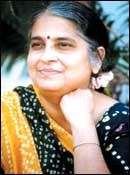
Showing posts with label Sudha Murthy. Show all posts

Wednesday, November 22, 2006

The Mother Teresa International Award

The Mother Teresa International Award was presented on the Sunday November 19, at the Taj President in Mumbai. The award is presented annually by the Harmony Foundation in association with the All India Christian Council.

Dr Mahathir Mohammed, former prime minister of Malaysia, was given the Mother Teresa International Award for Social Justice & Harmony.

Among the National awardees was Oscar Fernandes, union labour minister.
Other awardees included
Sudha Murthy (Rural Health Care),
Anna Hazare (Crusader for Public Causes),
TCS (Corporate Social Responsibility),
SEAL Org (Destitute Care ),
Teesta Setalvad (Human Rights)
Nitin Sardar (Welfare of Dalits and Tribals).

Friday, November 10, 2006

Sudha Murthy to act in teleserial

Bangalore, Nov 10: Writer Sudha Murthy, wife of Infosys chief mentor and non-executive chairman N R Narayana Murthy, will act in a television serial for the first time.

The chairperson of Infosys Foundation is playing the role of a judge in popular Kannada serial 'Preethi Illada Mele' being telecast by ETV.

"It's a first time for me. It's a new field. I am happy and looking forward to it", an excited Sudha Murthy told reporters.

If things go well, Sudha said, she would take up acting offers in future if happy with the roles.

Sudha has authored a dozen books some of which have been translated in different languages. (Agencies)

Original story

Thursday, October 19, 2006

I am not cut out for politics - Sudha Murthy

Sudha Murthy has carved out her own niche. She is not simply the wife of Narayana Murthy, but a woman who has shaped her own destiny. In an e xclusive interview with Prerna Shah, she talks about living the simple life.

Simple life
Simplicity comes naturally to me, I don't have to make an effort. That is because I come from a very middle class family. I don't believe in ostentatious displays of wealth – no one earns money just to show off.

Grandparents were an inspiration
My grandfather was a teacher; he and my grandmother lived in a village. They would describe the Somnath temple in intricate detail. But I later realised that they had never been to the temple, they never did in their lifetime. They were content with their life and I never once heard them grumble about anything.

Giving it away
In order to do charity, one must have his or her basic needs met. Many people think there is no big money going into charity from India, like the US. But I believe that as Indians we have begun experiencing wealth relatively later than the US or UK. When I see youngsters today, I am filled with a lot of hope. If they receive a good education and find promising jobs then they will certainly look forward to doing charity. But at the same time, I want every child to have an access to education, to a brighter future, and this privilege shouldn't be restricted to the moneyed few.

Politics isn't for me
I am not cut out for politics. I don't have those qualities. I like to concentrate on what I am doing now – working on projects that bring about a socio-economic change. And of course writing.

Gujarat beckons
I have a special regard for the state. It has a strong social work foundation and the people come across as simple and unassuming individuals. I also find their 'value for money' attitude very endearing. There is another bond – the Gujarati translation of my work sells very well!

What women want
I am always asked this question and I believe it is an important one. According to me, women want to be in charge of their destinies, they want change.

Original story

Wednesday, October 18, 2006

Sudha murty launches infosys foundation wing at BVB, Mysore

Mysore, Oct. 17 (BLU & KMC)- The Infosys Foundation Wing and Business Leadership Forum, at the Bhavan's Institute of Management in Mysore Kendra of Bharatiya Vidya Bhavan (BVB), Vijayanagar I Stage here, was inaugurated by Sudha Murty, Chairperson of Infosys Foundation, at a function held here this morning.

The function was presided over by BVB Karnataka Chairman N. Ramanuja. BVB Mysore Kendra Chairman A.V. Narasimha Murthy, Vice-Chairman K.B. Ganapathy, Hon. Secretary P.S. Ganapathy, Hon. Treasurer Krishnaraju and others were present.

Later, Sudha Murty participated in an interaction with the Institute students for about 90 minutes, replying to queries posed by them.

Did you face any financial problem when you started Infosys. What was your goal then?

Sudha Murty (SM): Money making was not our objective when we started the company. We emphasised on quality service and products. Lesser the capital, more the commitment towards the venture and the will to achieve. The period during 1981 to 1991 was very tough for us. There was no free economic policy then. But the scenario has changed since the past 10 years.

Who is a good entrepreneur?

SM: One who learns to convert his failures into success.

What is the secret of success of Infosys?

SM: Team-work based on faith and trust is our foundation.

Social obligations?

SM: Corporates and those having enough and more must share their wealth with society, especially the needy and poor.

Any personal achievement?

SM: (With humility) No, I have no such achievement to my credit. Humanity is very important. We must all have social responsibilities, but we neither should have any attachment nor detachment ...

Will you join politics?

SM: (Curtly) Why should I? I do not like politics because I lack certain qualities and mindset to be an ideal politician.

What are the opportunities for women entrepreneurs?

SM: It is true that women cannot work 24X7 like men, as they have to play the roles of a wife, a mother and daughter-in-law, etc.

How do you usually spend your spare time?

SM: These days I am more into social service activities through the Infosys Foundation.

What is the formula for your success?

SM: Honesty, timing, family support, element of luck, God's grace ...

What have you to say about mobility of labour?

SM: See, job-seekers go wherever opportunities are. These days there is a tough competition.

What is your inspiration for writing?

SM: Writing is my most intimate hobby. I did not learn from any University or from books. I have learnt from the poor people.

Original story

Wednesday, October 04, 2006

How Infosys Was Born - Sudha Murthy

This is written by Sudha Murthy in Ananda Vikatan newsletter, about her life and the story of how Infosys was born.

It was in Pune that I met Narayan Murty through my friend Prasanna who is now the Wipro chief, who was also training in Telco. Most of the books that Prasanna lent me had Murty's name on them, which meant that I had a preconceived image of the man. Contrary to expectations, Murty was shy, bespectacled and an introvert. When he invited us for dinner, I was a bit taken aback as I thought the young man was making a very fast move. I refused since I was the only girl in the group. But Murty was relentless and we all decided to meet for dinner the next day at 7.30p.m. At Green Fields hotel on the Main Road, Pune.

The next day I went there at 7 o'clock since I had to go to the tailor near the hotel. And what do I see? Mr. Murty waiting in front of the hotel and it was only seven. Till today, Murty maintains that I had mentioned (consciously!) that I would be going to the tailor at 7 so that I could meet him... And I maintain that I did not say any such thing consciously or unconsciously because I did not think of Murty as anything other than a friend at that stage. We have agreed to disagree on this matter. Soon, we became friends. Our conversations were filled with Murty's experiences abroad and the books that he has read.

My friends insisted that Murty was trying to impress me because he was interested in me. I kept denying it till one fine day, after dinner Murty said I want to tell you something. I knew this was it. It was coming. He said, "I am 5'4" tall. I come from a lower middle class family. I can never become rich in my life and I can never give you any riches. You are beautiful, bright, and intelligent and you can get anyone you want. But will you marry me?" I asked Murty to give me some time for an answer.

My father didn't want me to marry a wannabe politician, (a communist at that) who didn't have a steady job and wanted to build an orphanage...

When I went to Hubli I told my parents about Murty and his proposal. My mother was positive since Murty was also from Karnataka, seemed intelligent and came from a good family. But my father asked: What's his job, his salary, his Qualifications etc? Murty was working as a research assistant and was earning less than me. He was willing to go Dutch with me on our outings. My parents agreed to meet Murty in Pune on a particular day at 9 a.m. sharp. Murty did not turn up. How can I trust a man to take care of my daughter if he cannot keep an appointment, asked my father. At 12 noon, Murty turned up in a bright red shirt! He had gone on work to Bombay, was stuck in a traffic jam on the ghats, so he hired a taxi (though it was very expensive for him) to meet his would-be father-in-law.

Father was unimpressed. My father asked him what he wanted to become in life. Murty said he wanted to become a politician in the communist party and wanted to open an orphanage. My father gave his verdict. NO.

I don't want my daughter to marry somebody who wants to become a communist and then open an orphanage when he himself doesn't have money to support his family. Ironically, today, I have opened many orphanages, something, which Murty wanted to do 25 years ago. By this time, I realized I had developed a liking towards Murty, which could only be termed as love. I wanted to marry Murty because he is an honest man. He proposed to me highlighting the negatives in his life. I promised my father that I would not marry Murty without his blessings though at the same time, I cannot marry anybody else.

My father said he would agree if Murty promised to take up a steady job. But Murty refused saying he will not do things in life because somebody wanted him to. So, I was caught between the two most important people in my life.

The stalemate continued for three years during which our courtship took us to every restaurant and cinema hall in Pune. In those days, Murty was always broke. Moreover, he didn't earn much to manage. Ironically today, he manages Infosys Technologies Ltd.; one of the worlds's most reputed companies. He always owed me money. We used to go for dinner and he would say, I don't have money with me, you pay my share, and I will return it to you later. For three years I maintained a book on Murty's debt to me. No, he never returned the money and I finally tore it up after my wedding. The amount was a little over Rs. 4,000/-.

During this interim period, Murty quit his job as research assistant and started his own software business. Now, I had to pay his salary too! Towards the late 70s computers were entering India in a big way. During the fag end of 1977, Murty decided to take up a job as General Manager at Patni Computers in Bombay. But before he joined the company, he wanted to marry me since he was to go on training to the US after joining. My father gave in as he was happy Murty had a decent job now.

We were married in Murty's house in Bangalore on February 10, 1978 with only our two families present. I got my first silk sari. The wedding expenses came to only Rs. 800/- (US $ 17) with Murty and I pooling in Rs. 400/- each.

I went to the US with Murty after marriage. Murty encouraged me to see America on my own because I loved traveling. I toured America for three months on backpack and had interesting experiences, which will remain fresh in my mind forever. Like the time when I was taken into custody by the New York police because they thought I was an Italian trafficking drugs in Harlem. Or the time when I spent the night at the bottom of the Grand Canyon with an old couple. Murty panicked because he couldn't get a response from my hotel room even at midnight. He thought I was either killed or kidnapped.

In 1981Murty wanted to start Infosys. He had a vision and zero capital...

Initially, I was very apprehensive about Murty getting into business. We did not have any business background. Moreover, we were living a comfortable life in Bombay with a regular paycheck and I didn't want to rock the boat. But Murty was passionate about creating good quality software. I decided to support him. Typical of Murty, he just had a dream and no money. So I Gave him Rs 10,000/- that I had saved for a rainy day, without his knowledge and told him, this is all I have. Take it. I give you three years sabbatical leave. I will take care of the financial needs of our house. You go and chase your dreams without any worry. But you have only three years!

Murty and his six colleagues started Infosys in 1981, with enormous interest and hard work. In 1982, I left Telco and moved to Pune with Murty.

We bought a small house on loan, which also became the Infosys office. I was a clerk-cum-cook-cum-programmer. I also took up a job as Senior Systems Analyst with Watchband group of Industries to support the house.

In 1983, Infosys got their first client, MICO, in Bangalore. Murty moved to Bangalore and stayed with his mother while I went to Hubli to deliver my second child, Roan. Ten days after my son was born, Murty left for the US on project work. I saw him only after a year, as I was unable to join Murty in the US because my son had infantile eczema, an allergy to vaccinations. So for more than a year, I did not step outside our home for fear of my son contracting an infection. It was only after Roan got all his vaccinations that I came to Bangalore where we rented a small house in Jayanagar and rented another house as Infosys headquarters. My father presented Murty a scooter to commute. I once again became a cook, programmer, clerk, and secretary, office assistant et al. Nandan Nilekani (MD of Infosys) and his wife Rohini stayed with us. While Rohini babysat my son, I wrote programmes for Infosys. There was no car, no phone, just two kids and a bunch of us working hard, juggling our lives and having fun while Infosys was taking shape. It was not only me but the wives of other partners too who gave their unstinted support.

Murty made it very clear that it would either be me or him working at Infosys. Never the two of us together. I was involved with Infosys initially. Nandan Nilekani suggested I should be on the Board but Murty said he did not want a husband and wife team at Infosys. I was shocked since I had the relevant experience and technical qualifications. He said, Sudha if you want to work with Infosys, I will withdraw, happily. I was pained to know that I will not be involved in the company my husband was building and that I would have to give up a job that I am qualified to do and love doing. It took me a couple of days to grasp the reason behind Murty's request.

I realized that to make Infosys a success one had to give one's 100 percent. One had to be focused on it alone with no other distractions. If the two of us had to give 100 percent to Infosys, then what would happen to our home and our children? One of us had to take care of our home while the other took care of Infosys. I opted to be a homemaker, after all Infosys was Murty's dream. It was a big sacrifice but it was one that had to be made. Even today, Murty says, "Sudha, I stepped on your career to make mine. You are responsible for my success." I might have given up my career for my husband's sake. But that does not make me a doormat. Many think that I have been made the sacrificial lamb at Narayan Murty's altar of success.

A few women journalists have even accused me of setting a wrong example by giving up my dreams to make my husbands a reality. Isn't freedom about living your life the way you want it? What is right for one person might be wrong for another. It is up to the individual to make a choice that is effective in her life. I feel that when a woman gives up her right to choose for herself is when she crosses over from being an individual to doormat.

Murty's dreams encompassed not only himself but also a generation of people. It was about founding something worthy, exemplary and honorable. It was about creation and distribution of wealth. His dreams were grander than my career plans, in all aspects. So, when I had to choose between Murty's career and mine, I opted for what I thought was a right choice. We had a home and two little children. Measles, mumps, fractures, PTA meetings, wants and needs of growing children do not care much for grandiose dreams. They just needed to be attended to. Somebody had to take care of it all. Somebody had to stay back to create a home base that would be fertile for healthy growth, happiness, and more dreams to dream.

I became that somebody willingly. I can confidently say that if I had had a dream like Infosys, Murty would have given me his unstinted support. The roles would have been reversed. We are not bound by the archaic rules of marriage. I cook for him but I don't wait up to serve dinner like a traditional wife. So, he has no hassles about heating up the food and having his dinner. He does not intrude into my time especially when I am writing my novels. He does not interfere in my work at the Infosys Foundation and I don't interfere with the running of Infosys.

I teach Computer Science to MBA and MCA students at Christ college for a few hours every week and I earn around Rs 50, 000 a year. I value this financial independence greatly though there is no need for me to pursue a teaching career. Murty respects that. I travel all over the world without Murty because he hates traveling. We trust each other implicitly.

We have another understanding too. While he earns the money, I spend it, mostly through the charity. Philanthropy is a profession and an art. The Infosys Foundation was born in 1997 with the sole objective of uplifting the less-privileged sections of society. In the past three years we have built hospitals, orphanages, rehabilitation centres, school buildings, science centers and more than 3500 libraries.

Our work is mainly in the rural areas amongst women and children. I am one of the trustees and our activities span six states including Karnataka, Tamil Nadu, Andhra, Orissa, Chandigarh and Maharashtra. I travel to around 800 villages constantly. Infosys Foundation has a minimal staff of three trustees and three office members. We all work very hard to achieve our goals and that is the reason why Infosys Foundation has a distinct identity. Every year we donate around Rs 5-6 crore (Rs 50 - 60 million). We run Infosys Foundation the way Murty runs Infosys - in a professional and scientific way. Philanthropy is a profession and an art. It can be used or misused.

We slowly want to increase the donations and we dream of a time when Infosys Foundation could donate large amounts of money. Every year we receive more than 10, 000 applications for donations. Everyday, I receive more than 120 calls. Amongst these, there are those who genuinely need help and there are hood winkers too. I receive letters asking me to donate Rs. Five lakh to someone because five lakh is, like peanuts to Infosys. Some people write to us asking for free Infosys shares. Over the years I have learnt to differentiate the wheat from the chaff, though I still give a patient hearing to all the cases.

Sometimes, I feel I have lost the ability to trust people. I have become shrewder to avoid being conned. It saddens me to realize that even as a person is talking to me I try to analyse them: Has he come here for any donation? Why is he praising my work or enquiring about my health, does he wants some money from me? Eight out of ten times I am right. They do want my money. But I feel bad for the other two whom I suspected. I think that is the price that I have to pay for the position that I am in now.

The greatest difficulty in having money is teaching your children the value of it and trying to keep them on a straight line. Bringing up children in a moneyed atmosphere is a difficult task.

Even today, I think twice if I have to spend Rs. 10/- on an auto when I can walk up to my house. I cannot expect my children to do the same. They have seen money from the time they were born. But we can lead by example. When they see Murty wash his own plate after eating and clean the two toilets in the house everyday, they realize that no work is demeaning irrespective of how rich you are. I don't have a maid at home because I don't see the need for one. When children see both parents working hard, living a simple life, most of the time they tend to follow. This doesn't mean we expect our children to live an austere life. My children buy what they want and go where they want but they have to follow certain rules.

They will have to show me a bill for whatever they buy. My daughter can buy five new outfits but she has to give away five old ones. My son can go out with his friends for lunch or dinner but if he wants to go to a five star hotel, we discourage it. Or we accompany him. So far my children haven't given me any heartbreak. They are good children. My eldest daughter is studying abroad, whereas my son is studying in Bangalore. They don't use their father's name in vain. If asked, they only say that his name is Murty and that he works for Infosys. They don't want to be recognized and appreciated because of their father or me but for themselves. I don't feel guilty about having money for we have worked hard for it. But I don't feel comfortable flaunting it.

It is a conscious decision on our part to live a simple, so-called middle class life. We live in the same two-bedroom, sparsely furnished house we had before Infosys became a success. Our only extravagance is buying books and CDs. My house has no lockers for I have no jewels. I wear a stone earring, which I bought in Bombay for Rs. 100/-. I don't even wear my mangalsutra until i attend some family functions or I am with my mother-in-law. I am not fond of jewellery or saris. Five years ago, I went to Kashi where tradition demands that you give up something and I gave up shopping.

I still have the same sofa at home, which my daughter wants to change. However, we have indulged ourselves with each one having their own music system and computer. I don't carry a purse and neither does Murty most of the time. I do tell him to keep some small change with him but he doesn't. I borrow money from my secretary or my driver if I need cash. They know my habit so they always carry extra cash with them. But I settle the accounts every evening. Murty and I are very comfortable with our lifestyle and we don't see the need to change it now that we have money.

Murty and I are two opposites that complement each other... Murty is sensitive and romantic in his own way. He always gifts me books addressed as "From Me to You", or "To the person I most admire", etc. We both love books. We are both complete opposites. I am an extrovert and he is an introvert. I love watching movies and listening to classical music. Murty loves listening to English classical music. I go out for movies with my students and secretary every other week. I am still young at heart. I really enjoyed watching "Kaho Na Pyaar Hai" and I am a Hrithik Roshan fan. It has been more than 20 years since Murty and I went for a movie. My daughter once gave us a surprise by booking tickets for Titanic. Since I had a prior engagement that day, Murty went for the movie with his secretary Pandu. I love traveling whereas Murty loves spending time at home.

But that doesn't mean I don't have true friends. I do have genuine friends, a handful, who have been with me for a very long time. My equation with these people has not changed and vice versa. I am also very close to Narayan Murty's family, especially my sister-in-law Kamala Murty, a schoolteacher, who is more of a dear friend to me. I have discovered that these are the few relationships and friendships that don't fluctuate depending on the price of Infosys shares.

Have I lost my identity as a woman, in Murty's shadow? No. I might be Mrs. Narayan Murty. I might be Akshata and Rohan's mother. I might be the trustee of Infosys Foundation. But I am still Sudha. I play different roles like all women. That doesn't mean we don't have our own identity.

Women have that extra quality of adaptability and learn to fit into different shoes. But we are our own selves still. And we have to exact our freedom by making the right choices in our lives, dictated by us and not by the world.

Original story

Monday, September 18, 2006

Remembering JRD Tata and Jamsetji Tata - Sudha Murthy

- An article by Sudha Murthy

Sudha Murty was livid when a job advertisement posted by a Tata company at the institution where she was completing her post graduation stated that 'lady candidates need not apply'. She dashed off a postcard to JRD, protesting against the discrimination. It was the beginning of an association that would change her life in more ways than one

There are two photographs that hang on my office wall. Every day when I enter my office I look at them before starting my day. They are pictures of two old people. One is of a gentleman in a blue suit and other is a black-and-white image of a man with dreamy eyes and a white beard.

People have asked me if the people in the photographs are related to me. Some have even asked me, "Is this black-and-white photo that of a Sufi saint or a religious guru?" I smile and reply "No, nor are they related to me. These people made an impact on my life. I am grateful to them." "Who are they?" "The man in the blue suit is Bharat Ratna JRD Tata and the black-and-white photo is of Jamsetji Tata." "But why do you have them in your office?" "You can call it gratitude."

Then, invariably, I have to tell the person the following story.

It was a long time ago. I was young and bright, bold and idealistic. I was in the final year of my master's course in computer science at the Indian Institute of Science [IISc] in Bangalore, then known as the Tata Institute. Life was full of fun and joy. I did not know what helplessness or injustice meant.

It was probably the April of 1974. Bangalore was getting warm and red gulmohars were blooming at the IISc campus. I was the only girl in my postgraduate department and was staying at the ladies' hostel. Other girls were pursuing research in different departments of science. I was looking forward to going abroad to complete a doctorate in computer science. I had been offered scholarships from universities in the US. I had not thought of taking up a job in India.

One day, while on the way to my hostel from our lecture-hall complex, I saw an advertisement on the notice board. It was a standard job-requirement notice from the famous automobile company Telco [now Tata Motors]. It stated that the company required young, bright engineers, hardworking and with an excellent academic background, etc.

At the bottom was a small line: "Lady candidates need not apply." I read it and was very upset. For the first time in my life I was up against gender discrimination.

Though I was not keen on taking up the job, I saw it as a challenge. I had done extremely well in academics, better than most of my male peers. Little did I know then that in real life academic excellence is not enough to be successful.

After reading the notice I went fuming to my room. I decided to inform the topmost person in Telco's management about the injustice the company was perpetrating. I got a postcard and started to write, but there was a problem: I did not know who headed Telco. I thought it must be one of the Tatas. I knew JRD Tata was the head of the Tata Group; I had seen his pictures in newspapers (actually, Sumant Moolgaokar was the company's chairman then).

I took the card, addressed it to JRD and started writing. To this day I remember clearly what I wrote. "The great Tatas have always been pioneers. They are the people who started the basic infrastructure industries in India, such as iron and steel, chemicals, textiles and locomotives. They have cared for higher education in India since 1900 and they were responsible for the establishment of the Indian Institute of Science. Fortunately, I study there. But I am surprised how a company such as Telco is discriminating on the basis of gender."

I posted the letter and forgot about it. Less than 10 days later, I received a telegram stating that I had to appear for an interview at Telco's Pune facility at the company's expense. I was taken aback by the telegram. My hostel mates told me I should use the opportunity to go to Pune free of cost and buy them the famous Pune saris for cheap! I collected Rs 30 each from everyone who wanted a sari. When I look back, I feel like laughing at the reasons for my going, but back then they seemed good enough to make the trip.

It was my first visit to Pune and I immediately fell in love with the city. To this day it remains dear to me. I feel as much at home in Pune as I do in Hubli, my hometown. The place changed my life in so many ways.

As directed, I went to Telco's Pimpri office for the interview. There were six people on the panel and I realised then that this was serious business. "This is the girl who wrote to JRD," I heard somebody whisper as soon as I entered the room. By then I knew for sure that I would not get the job. That realisation abolished all fear from my mind, so I was rather cool while the interview was being conducted.

Even before the interview started, I reckoned the panel was biased, so I told them, rather impolitely, "I hope this is only a technical interview." They were taken aback by my rudeness, and even today I am ashamed about my attitude.

The panel asked me technical questions and I answered all of them. Then an elderly gentleman with an affectionate voice told me, "Do you know why we said lady candidates need not apply? The reason is that we have never employed any ladies on the shop floor. This is not a co-ed college; this is a factory. When it comes to academics, you are a first ranker throughout. We appreciate that, but people like you should work in research laboratories."

I was a young girl from small-town Hubli. My world had been a limited place. I did not know the ways of large corporate houses and their difficulties, so I answered, "But you must start somewhere, otherwise no woman will ever be able to work in your factories."

Finally, after a long interview, I was told I had been successful. So this was what the future had in store for me. Never had I thought I would take up a job in Pune. I met a shy young man from Karnataka there, we became good friends and we got married.

It was only after joining Telco that I realised who JRD was: the uncrowned king of Indian industry. Now I was scared, but I did not get to meet him till I was transferred to Bombay. One day I had to show some reports to Mr Moolgaokar, our chairman, who we all knew as SM. I was in his office on the first floor of Bombay House [the Tata headquarters] when, suddenly, JRD walked in. That was the first time I saw 'appro JRD'. Appro means 'our' in Gujarati. That was the affectionate term by which people at Bombay House called him.

I was feeling very nervous, remembering my postcard episode. SM introduced me nicely, "Jeh (that's what his close associates called him), this young woman is an engineer and that too a postgraduate. She is the first woman to work on the Telco shop floor." JRD looked at me. I was praying he would not ask me any questions about my interview (or the postcard that preceded it). Thankfully, he didn't. Instead, he remarked. "It is nice that girls are getting into engineering in our country. By the way, what is your name?" "When I joined Telco I was Sudha Kulkarni, Sir," I replied. "Now I am Sudha Murty." He smiled that kindly smile and started a discussion with SM. As for me, I almost ran out of the room.

After that I used to see JRD on and off. He was the Tata Group chairman and I was merely an engineer. There was nothing that we had in common. I was in awe of him.

One day I was waiting for Murthy, my husband, to pick me up after office hours. To my surprise I saw JRD standing next to me. I did not know how to react. Yet again I started worrying about that postcard. Looking back, I realise JRD had forgotten about it. It must have been a small incident for him, but not so for me.

"Young lady, why are you here?" he asked. "Office time is over." I said, "Sir, I'm waiting for my husband to come and pick me up." JRD said, "It is getting dark and there's no one in the corridor. I'll wait with you till your husband comes." I was quite used to waiting for Murthy, but having JRD waiting alongside made me extremely uncomfortable.

I was nervous. Out of the corner of my eye I looked at him. He wore a simple white pant and shirt. He was old, yet his face was glowing. There wasn't any air of superiority about him. I was thinking, "Look at this person. He is a chairman, a well-respected man in our country and he is waiting for the sake of an ordinary employee."

Then I saw Murthy and I rushed out. JRD called and said, "Young lady, tell your husband never to make his wife wait again."

In 1982 I had to resign from my job at Telco. I was reluctant to go, but I really did not have a choice. I was coming down the steps of Bombay House after wrapping up my final settlement when I saw JRD coming up. He was absorbed in thought. I wanted to say goodbye to him, so I stopped. He saw me and paused.

Gently, he said, "So what are you doing, Mrs Kulkarni? (That was the way he always addressed me.) "Sir, I am leaving Telco." "Where are you going?" he asked. "Pune, sir. My husband is starting a company called Infosys and I'm shifting to Pune." "Oh! And what you will do when you are successful?" "Sir, I don't know whether we will be successful." "Never start with diffidence," he advised me. "Always start with confidence. When you are successful you must give back to society. Society gives us so much; we must reciprocate. I wish you all the best."

Then JRD continued walking up the stairs. I stood there for what seemed like a millennium. That was the last time I saw him alive.

Many years later I met Ratan Tata in the same Bombay House office, occupying the chair JRD once did. I told him of my many sweet memories of working with Telco. Later, he wrote to me, "It was nice hearing about Jeh from you. The sad part is that he's not alive to see you today."

I consider JRD a great man because, despite being an extremely busy person, he valued one postcard written by a young girl seeking justice. He must have received thousands of letters every day. He could have thrown mine away, but he didn't do that. He respected the intentions of that unknown girl, who had neither influence nor money, and gave her an opportunity in his company. He did not merely give her a job; he changed her life and mindset forever.

Close to 50 per cent of the students in today's engineering colleges are girls. And there are women on the shop floor in many industry segments. I see these changes and I think of JRD. If at all time stops and asks me what I want from life, I would say I wish JRD were alive today to see how the company we started has grown. He would have enjoyed it wholeheartedly.

My love and respect for the House of Tata remains undiminished by the passage of time. I always looked up to JRD. I saw him as a role model for his simplicity, his generosity, his kindness and the care he took of his employees. Those blue eyes always reminded me of the sky; they had the same vastness and munificence.

* Sudha Murty is the chairperson of the Infosys Foundation. She is involved in a number of social development initiatives and is also a widely published writer.

Full story

JRD Tata's Words Inspired me in Philanthropy: Sudha Murthy

Did anybody know that there was a strong Tata connection to Infosys? Meet Ms Sudha Murthy, the better half of the Infosys chairman, NR Narayana Murthy. On a down-the-memory-lane visit here after 25 years, Ms Murthy, who is now heading the Infosys Foundation, said it was a chance association with the house of Tatas when after topping the graduating class in computer science from the Indian Institute of Science, Bangalore, she came across a job advertisement in February 1974, which said Telco (Tata Engineering and Locomotive Company) wanted bright young graduates.

However, much to her disappointment, she found in the footnote it was written "female candidates need not apply." Her ego deeply hurt, she shot off a 'postcard' to JRD Tata asking him how a leading and progressive house like the Tatas, "which always thought ahead of time, could put such a restriction." "After posting it I forgot about it," she said. A pleasant surprise awaited her. A telegram soon arrived asking her to appear for an interview "with a promise of reimbursement of first class fare both ways," she said.

Selected as a GT (graduate trainee) and as the first lady technical officer at Telco, she was first posted to Pune and was later shifted to Telco Jamshedpur "for a short stint." She was thereafter shifted to Bombay House, She had later learnt that JRD had himself intervened in the matter following her letter and had instructed the board that "if she was found up to the mark in her subjects, she should be taken." She recalls how after having put in her papers in February 1982, after having served Telco for eight years, she wanted to meet JRD to convey her gratitude.

"It was again a chance meeting as I was going downstairs and he was climbing upstairs in Bombay House," she told reporters here Monday. "I told him I was leaving the job. He said "you fought so much for the job and nowyou are quitting it?" I told him that my husband wanted to start the Infosys Adventure. And then JRD turned almost a soothsayer to say, "If you make lots of money you must give it back to society as you have received so much love from it." "That was the last time I saw him," the lady, clad in simple clothes, said regretfully.

This was to be the source of the inspiration for Infosys Foundation which she today manages to run in Karnataka, Andhra Pradesh, Tamil Nadu and Orissa "with only six hands." So strong has been the influence of the Tatas that when asked by her colleagues as to what she wanted on her retirement, she could only say: "A black & white portrait of Jamshetji Nusserwanji Tata and another of JRD Tata in his famous blue suit."

"At Infosys, we have the two biggest and the most expensive boardrooms (of a total of 17) where world leaders like Tony Blair, etc, are felicitated, named after these two great personalities," she says proudly. The Infosys Foundation focuses on two basic things: education and health. "We provide infrastructure to the states for building government hospitals," she says. Asked, how was it helping the poor, given the poor state of affairs at government hospitals, Ms Murthy says: "The poor have no other place to go other than to a government hospital."

The foundation, among other things, also donates books to libraries of schools for the less privileged. "The creation of wealth by legal and ethical means is one part," she maintains. "The distribution of wealth is the other part. The Infosys Foundation focuses on the poorest of the poor." Recipient of several international and national awards for outstanding philanthropic work, the chairperson of Infosys Foundation feels that Indian corporates should "do much more for the society," particularly in health and education. Anybody in her place would be having a I high-flying lifestyle.

Full story